Apr 4
Written By Ky Khalil
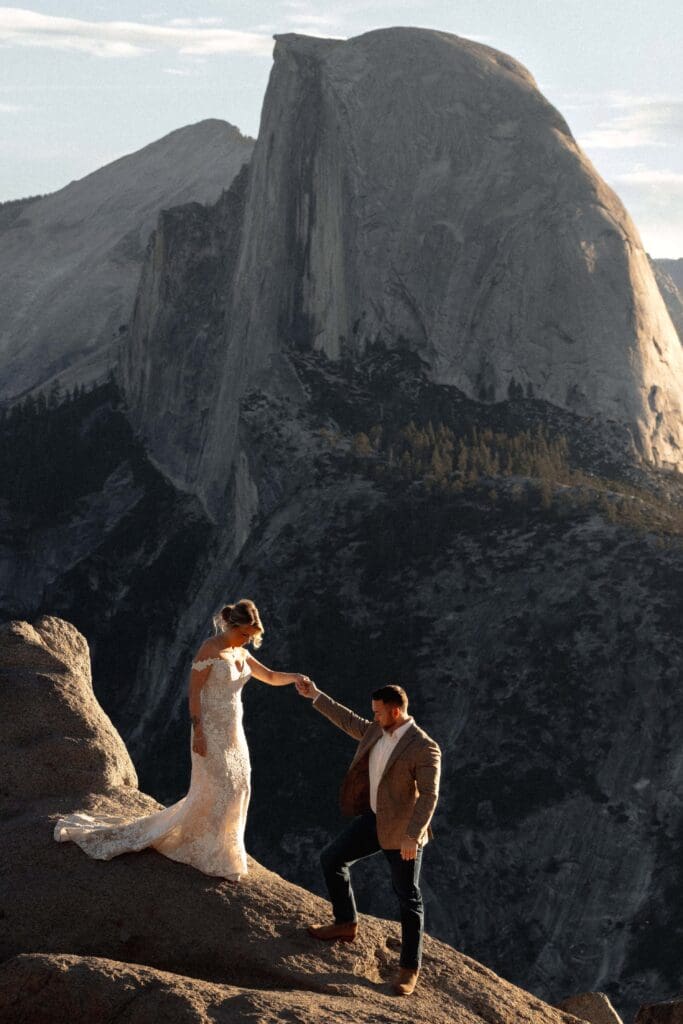
There’s a reason why climbers call Yosemite “the center of the universe,” why people feel called to return to its glacially carved valleys again and again, and why you’re here right now, pondering what it would mean to marry your person in the place that is, according to Ansel Adams, “the very heart of the earth speaking to us.”
The mountains are calling, but not just any mountains. There is a gravity, here, somewhere between the falls roaring down immense cliff faces, the alpine meadows teeming with life, and the storied Sierra light that draws you in; this, I understand.
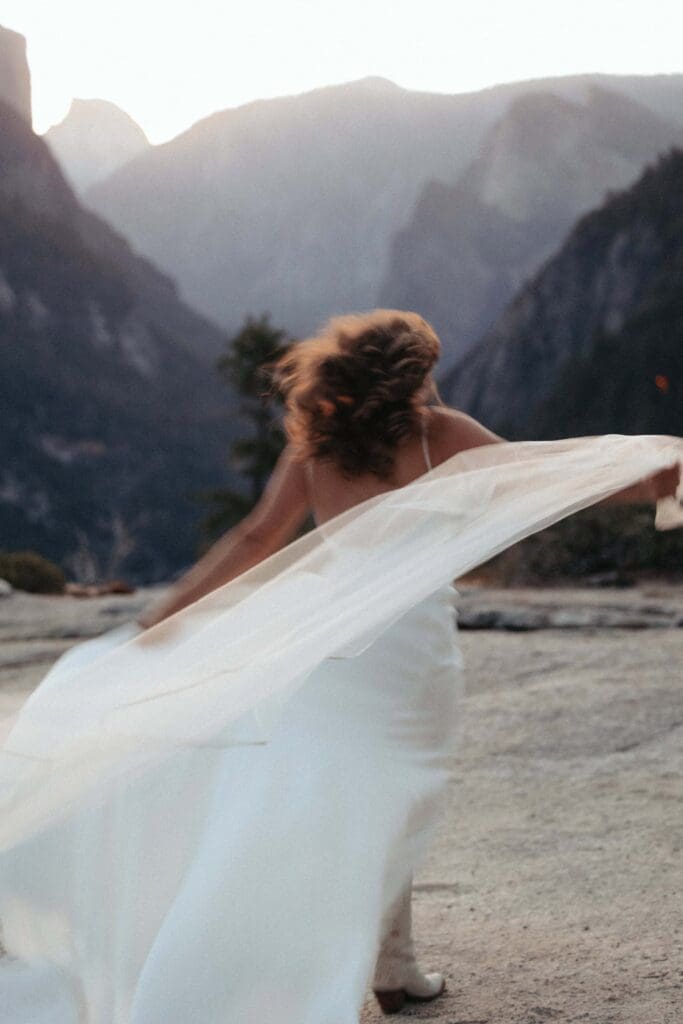
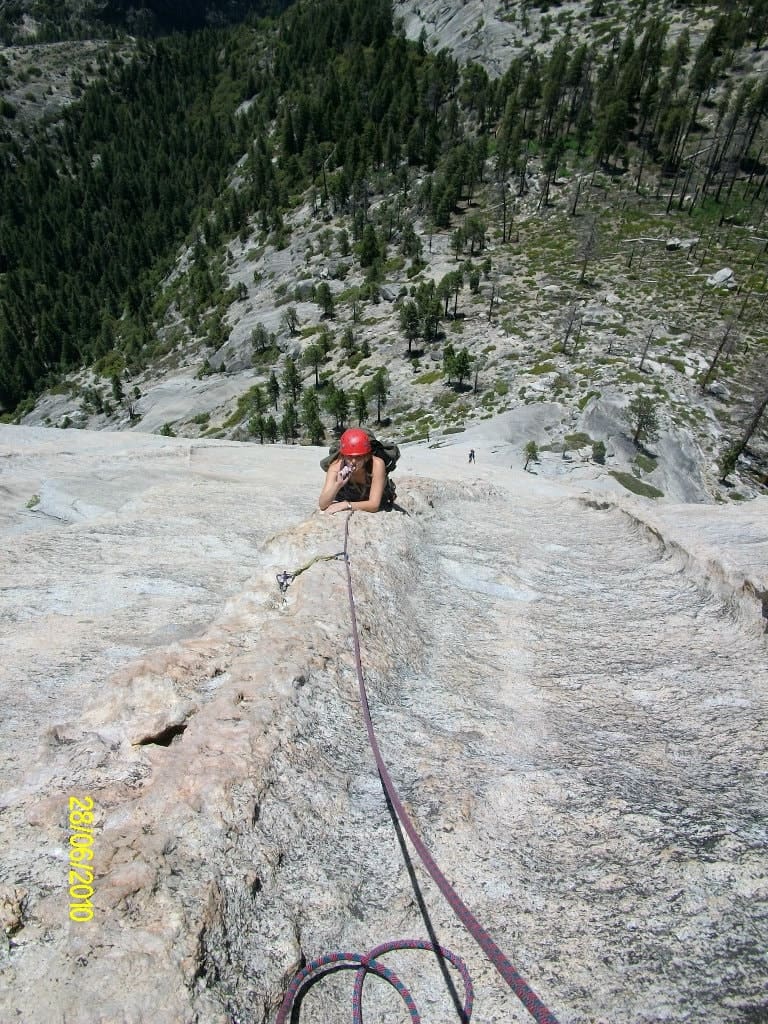
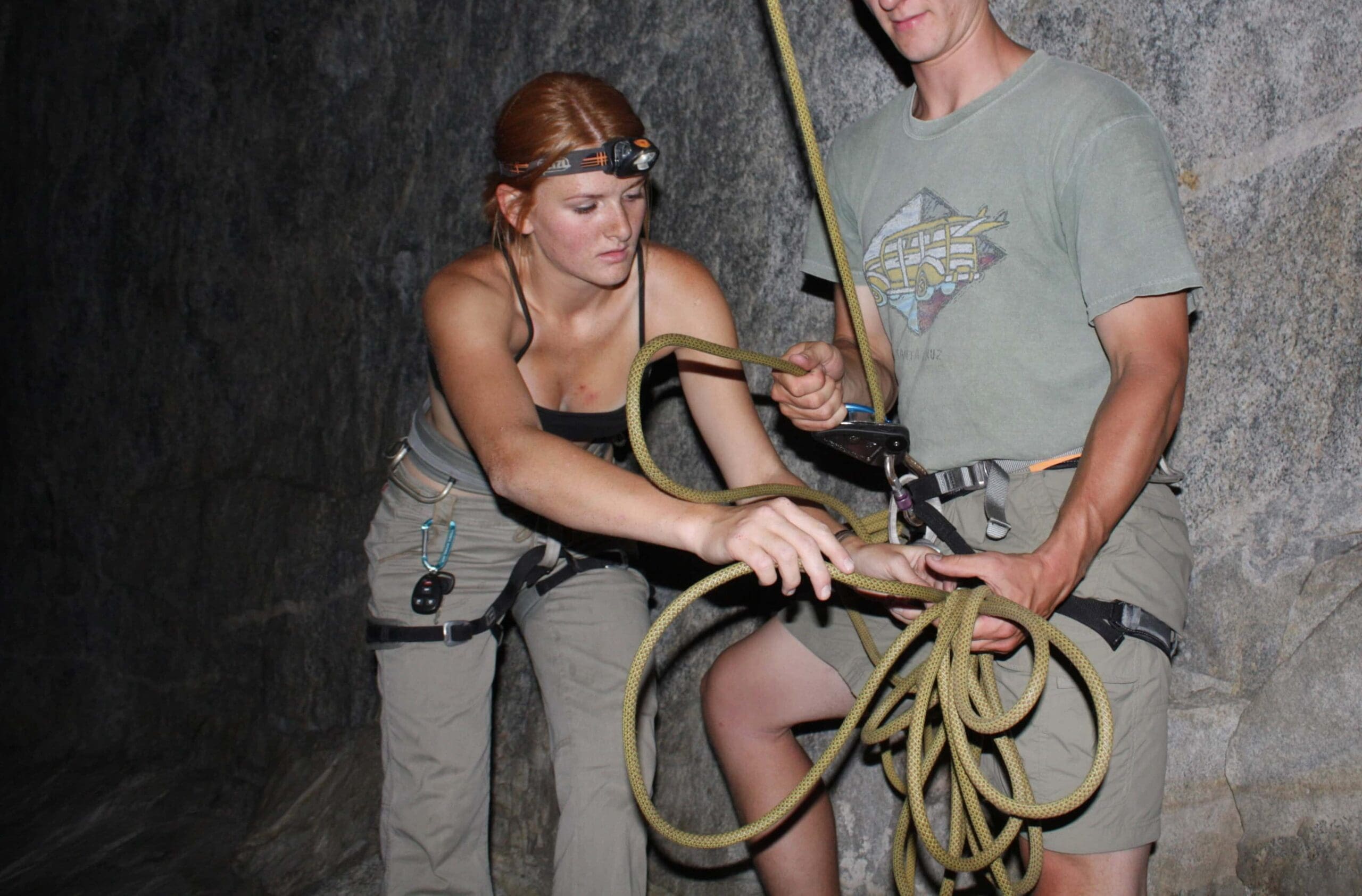
I’ve walked, biked, climbed, and driven this world heritage site on more occasions than I can count, and the sheer scale still catches me off guard. The massive granite monoliths are themselves mythic characters that have inspired and shaped destinies in countless stories. I started visiting Yosemite as a kid, on camping trips with my dad in the 90s. He’d point out the tiny climbers way up on the massive granite walls and say to me, “nuts, right? Isn’t that just nuts?” (Jumpscare to me on those very walls 15 years later – sorry, dad!).
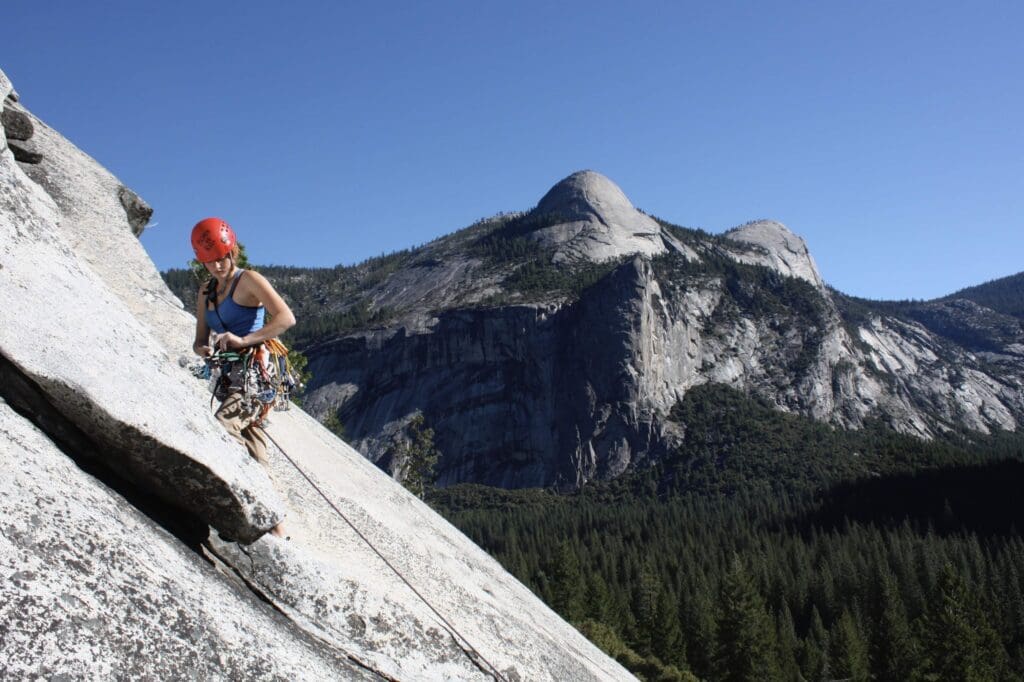
Instead of abstracting into pretty memories, Yosemite’s mythology rooted itself into my bones, and I came and went to the park until, one time in my early 20s, I stayed: this time, to work and live in the park. For six consecutive months I learned the Valley’s rhythms, explored her every corner, and did my part within the arteries that kept the park operating for its 3.9 million visitors that year.
I started my tenure concierging at The Lodge’s front desk, helping visitors orient and plan their stays, and later transitioned to work by the water so I could be outside every day and watch the valley light shift hour by hour. I’d ride my bike home from work as the sun set on Half Dome, an absolutely unbeatable commute. Yosemite became the place where adventure and real life stopped being separate endeavors for me.
I would be remiss not to mention the cast of characters the valley drew are a story in and of themselves, many of whom I still keep in touch with today. Each were drawn to the valley for their own reasons; none of us left unchanged.
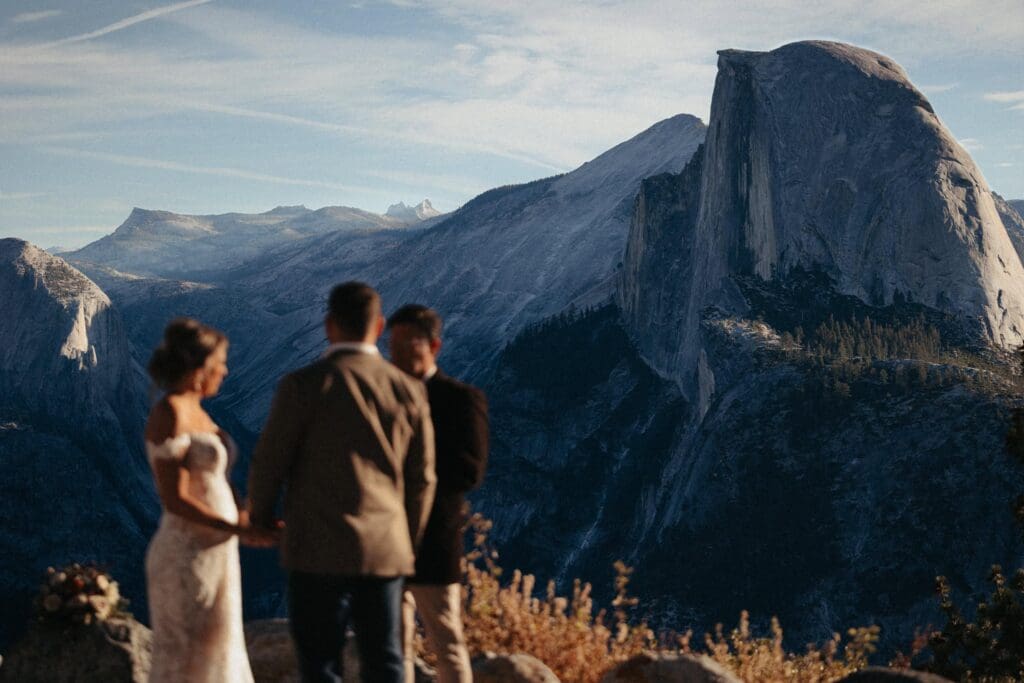
You and I aren’t the only ones who know of Yosemite’s magic, though, and even as park visitation balloons to over 4.2 million visitors in recent years, I know from my time there that solitude, presence, and privacy are still possible – but it depends on how you approach it. There are a number of interacting variables to keep in mind for managing crowds, timing, and the park regulations that exist to protect + preserve its fragile ecosystems.
This place will give you something unforgettable as you start this new chapter with the love of your life: it will give you a setting that feels like the center of adventure, alive with wonder and witness, brimming with mountainous characters you can tell your stories to again and again.
I wrote this guide to walk you through how to approach eloping in Yosemite with all of this in mind, using everything I learned from living and working inside the park, so that you feel at ease and grounded as you make critical decisions about your next greatest adventure.
〰️ Yosemite Elopement Guide Contents 〰️ Jump to a Section 〰️
- Current Yosemite Elopement Conditions + Live Update Hub
- Is Yosemite Right for Your Elopement? Why Choose Yosemite for Your Elopement?
- Current Yosemite Elopement Permits, CA Marriage Licenses, and Regulations (Updated for 2026)
- What does it cost to get married in Yosemite?
- Best Yosemite Elopement Locations
- When to Elope in Yosemite: What Day of the Week and What Season?
- The Yosemite Privacy Playbook
- Fun Elopement Activity Ideas: Ways to hang with your hottest homie
- Where to Stay in and Near Yosemite National Park
- What to Bring on Your Yosemite Elopement
- Yosemite Elopements: What Can Go Wrong
- How to find the best photographer for a Yosemite Elopement
- Frequently Asked Questions
Let’s get to it! →
Current Yosemite Elopement Conditions + Live Update Hub
Yosemite changes constantly. Road access, weather, even how you enter the park will shift throughout the year. Instead of trying to summarize everything here (and risk it being outdated the moment you read it), I’ve created a hub here that links you directly to the sources I check when I’m planning elopements in the park.
If you’re in the early stages of planning – curious about what the weather is like this time of year, what roads are open or closed, etc – this is a great place to start.
🔗 Current alerts, conditions, road status, and Yosemite Conservancy Webcam of Yosemite Falls. 🏞️
🚧 Trying to make a guess at road opening dates? Check out 🔗 historical road closure and opening data (logged since 1980!).
🌤️ NOAA forecasts: 🔗 What’s the weather like in Yosemite Valley today, vs. what’s the weather like 🔗 up at Taft point, for example?
🔗 Current Park Entrance Requirements – No vehicle entry reservation requirement as of Feb 2026. Park entrance fee still applies ($ daily pass or $80 America the Beautiful Pass). Expect lines and pack patience for peak season.
👰♂️ Yes, you need a permit to get married in Yosemite. Don’t worry, I will walk you right through it!
Is Yosemite Right for Your Elopement? Why Choose Yosemite for Your Elopement?
Bottom line: Yosemite can absolutely give you the kind of intimate, meaningful experience most people are hoping for when they choose to elope here. That experience is shaped by how you approach the place. Timing, movement, and expectations matter.
If John Muir’s words resonate with you, and you feel drawn to Yosemite, then know that Yosemite has a place for you and your vows. Our national parks are truly for all of us, and I believe that anyone and everyone can have an incredible wedding or elopement here. The park meets countless people with countless ways of moving through the world.
Do you need to be someone who can hike 12 miles to elope in Yosemite? Absolutely not. Can you have a wild, physically demanding, deeply adventurous elopement here? Absolutely, the options are endless (If you are a climbing couple who wants to summit Half Dome when the cables are down and get married on top, I am already on board. A cables-down Half Dome ascent is still one of the coolest experiences I’ve had out here).
The question is what you are actually looking for, and how you want to feel while you’re here.
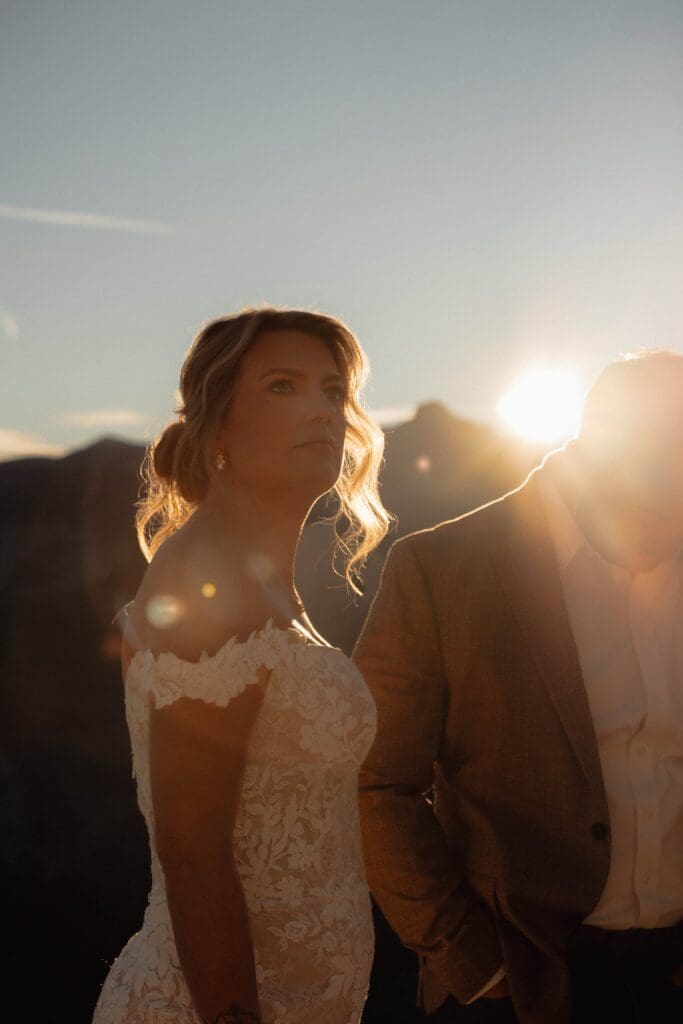
Some people arrive wanting scale, and the iconic spectacle of Yosemite’s best-known viewpoints. Some come looking for quiet and solitude, and are willing to step off-the-beaten path to find it. Some want to experience both, and don’t yet know how to jigsaw all the moving parts in a place that sees millions of visitors each year, with permitting and logistics layered in.
Yosemite is an incredible place to get married. I will also be upfront and realistic about what this setting asks of you depending on what you are looking for. Yosemite tends to be a strong fit for a couple who has bandwidth to work with a few moving parts, and who are open to shoulder-season, weekday elopement timing.
No outdoor setting truly is predictable, and Yosemite adds additional logistical layers that can push against certainty (road closures, crowd avoidance, parking, cell service, shifting entry requirements). Your experience here is shaped by how you move through those variables.
If you like mornings, you will feel at home here. Sunrise is the quietest time in the park.
If you’re an introvert’s introvert and solitude is the most important factor for your elopement, Yosemite does not give that up easily at her most iconic viewpoints outside the hours of… oh, say midnight and 5 am 😉
If being around other visitors at any point during the day would take you out of the experience, you may want to choose a different location. At the same time, solitude can exist here. It comes from knowing where to go, when to go, and how to approach the day. I don’t publish these spots openly due to their secluded nature, but just know they are up my sleeve. 🙂
Read on for more thoughts on location, timing, and privacy!
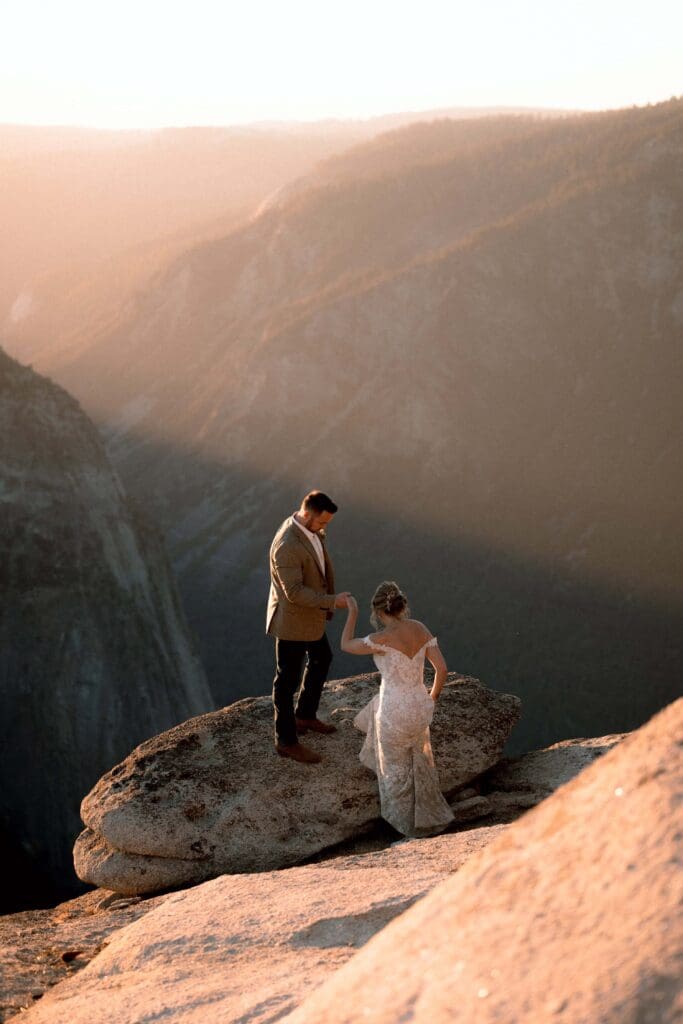
The bottom line is, there is way more space in the park than people realize, and I know places. There may be people about at some of the more iconic places, but we don’t have to go where they are, and it’s my job to make sure you don’t have to worry about crowds showing up in your photos.
Current Yosemite Elopement Permits, CA Marriage Licenses, and Regulations (Updated for 2026)
Bottom line: If you’re having a marriage ceremony in the park, you need a $150 Special Use permit to get married in Yosemite. Ceremony locations are limited to designated areas if your group is larger than 10. Smaller groups can customize ceremony location to just about anywhere in the park as long as Leave No Trace and impact policies are followed (read: don’t trample the meadows!)
During that stint working for the park in 2010, I remember riding my bike by a wedding party. “Congratulations!” I called out. The sun was shining, the river was chattering, the newlyweds were beaming, and the photographer lifted her camera to snap a photo of me as I rode by hands-free on my bike, in my backwards ballcap and tie-dye t-shirt.
I still wonder occasionally if that photo of me ended up in someone’s final gallery or photo album. It’s exactly the kind of picture I’d take to immortalize one small detail of what it felt like to get married in a National Park.
Anyway, all this to say, that couple needed a permit to hold their ceremony in the park back in 2010, and you’re going to need one to hold a ceremony now, too. That part of Yosemite wedding regulation never changes.
Why you’re seeing conflicting information online
If you’ve been researching Yosemite elopements for a while, you’ve probably noticed that different sites say slightly different things about permits, guest limits, and what’s allowed. The information available really does vary, and it can be so frustrating when you just want to know what is actually true.
Let’s start by talking about why you might be seeing conflicting information.
Yosemite updates its permitting process over time. Locations are adjusted, guest limits shift, and access changes depending on conditions in the park. A blog post written even two or three years ago can be partially out of date.
Some information online is simplified to make it easier to read. In reality, the rules are more specific and depend on the exact location, group size, and timing.
Some photographers are writing from personal experience that applied to a specific year or legislative moment. That experience can still be useful, but it doesn’t always translate directly to the facts on the ground now as they relate to your plan.
And sometimes, people are working from secondhand information rather than the current National Park Service guidelines.
The result is a mix of correct, outdated, and partially accurate information circulating at the same time.
The most reliable way to approach Yosemite permitting is to treat any single source as a starting point, then confirm details against current park guidance or with someone who is actively working in the park and tracking those changes.
I build every Yosemite elopement plan around what is current and actually workable.
What can change…
Let’s start with this, because this is the part that trips people up. These are the things that can change/shift/fluctuate:
- Permit office response times
- Permit fees
- Crowds and privacy factors
- Road closures
- Guest limits and approved locations can shift (but haven’t in a few years)
- Entry reservation systems (for example, reservations are no longer required to enter the park as of Feb 2026)
Changes like this are normal for a park that sees over four million visitors a year and has to actively manage visitor impact.
In most cases, additional photography permits are no longer required for events with eight or fewer individuals. For larger groups, a film photography permit may apply.
What’s always true
If you’re planning to get married in Yosemite, you need to complete and submit a Special Use Permit through the National Park Service, which currently costs $150 that needs to be submitted via check or money order with the mail-in application. That part is simple, straightforward, and current as of 2026.
To complete the Special Use permit needed to hold a ceremony in Yosemite, you simply need to choose a location (read on for more info on ceremony locations) and then download and complete the application, and then mail it to:
Special Park Uses/Film and Weddings
Yosemite National Park, National Park Service
P.O. Box 700
El Portal, CA 95318
Get on this ASAP – the permit office often needs multiple weeks of lead time to process applications. Once your permit is approved, the rest of the plan can officially start to take shape.
Permits can be scheduled up to one year in advance, but no fewer than 21 days prior to the event. This is always true.
Entrance fees into the park are not waived for ceremony participants or guests. More policy and event management information can be found at this link – or keep reading, I’ll explain it all!
Designated Ceremony Locations for groups of 10+
If your guest count is over ten people, you’ll need to choose a designated ceremony location from their site list in order to complete the permit application. The reason for this is these locations are scaled for impact that comes with larger groups. Check those sites out at this link or keep reading, I’ll go over them all in the next section.
If your guest count is fewer than 10 people, however, you have access to pretty much the entirety of the park with the exception of open meadows, riparian environments, and particular places such as the bases of the Giant Sequoia trees (due to fragile ecosystems and trample impact).
Ceremony locations are first-come, first-served and limited to two hours max at all locations. You’ll be contacted by their offices if your location or date isn’t available. Morning time frames are recommended for all locations as they get crowded as the day goes on.
Capacity varies, but most ceremony locations can accommodate up to 50 people, some fewer, and one location can accommodate up to 100 people (Sentinel Beach Picnic Area). A number of sites are wheelchair accessible (marked below). Some locations require the presence of a park ranger to monitor larger group sizes, which involves an additional fee of $50/hour.
Below is an at-a-glance overview of the DESIGNATED Ceremony locations for groups larger than 10, updated as of 2026, with guest and vehicle limits, monitoring requirements, and accessibility information.
YOSEMITE VALLEY
Cascades Picnic Area (can accommodate groups up to 30; 8 vehicle limit)
Lower Yosemite Fall Paved Trail (groups up to 50, monitoring required for groups of 50) ♿
Swinging Bridge Picnic Area (groups up to 20) ♿
Cathedral Beach Picnic Area (groups up to 50, monitoring required for groups of 35+; 6 vehicle limit)
Sentinel Beach Picnic Area (groups up to 100; monitoring required for groups of 50+; 8 vehicle limit) ♿
Bridalveil Fall (groups up to 50; monitoring required for groups of 50) ♿
WAWONA
Glacier Point Ampitheater, Elev. 7214 ft. (groups up to 50; monitoring required for groups 35+) ♿
Chilnualna Falls Trailhead Parking Lot (groups up to 50; monitoring required for groups of 35+; 10 vehicle limit)
TUOLUMNE MEADOWS
Tenaya Lake Beach, Elev. 8150 ft. (groups up to 50; monitoring required for groups of 50) (100 yd unpaved hike)
Tuolumne Meadows Lodge Area, Elev. 8600 ft. (groups up to 25) (250 yd unpaved hike)
BIG OAK FLAT
Tuolumne Grove, Elev. 6200 ft. (groups up to 30) (2.5 mile round trip paved hike, easy)
Merced Grove, Elev. 6000 ft. (groups up to 30) (3 mile round trip unpaved hike, moderate)
Once you have chosen your location, you can complete your permit! I am here to walk you through the application if you need help 🙂
Once complete, get a cute stamp and mail the original application with payment (check or money order) to:
Mail by post:
Special Park Uses/Film and Weddings
Yosemite National Park, National Park Service
P.O. Box 700
El Portal, CA 95318
Overnight (FedEx/UPS):
Special Park Uses/Film & Weddings
Yosemite National Park
5083 Foresta Rd
El Portal, CA 95318
For further wedding permit information, contact Catherine by email or by phone 209/379-1858.
Permits cannot be processed until the permit office receives your original application and any required payments.
California Marriage Licenses
You’ll also need a California marriage license to make things official. This is obtained separately from your Yosemite permit through any county clerk’s office in California. You do not need to be a CA resident to get married in CA.
Costs vary slightly by county, but most fall in the range of $60–$120.
You don’t have to get your license in the same county as Yosemite. Many couples choose to handle this in a nearby town (like Mariposa or Groveland) or in their home area before traveling.
You and your fiancé will need to show up to the County Clerk’s office in person with valid government ID in order to receive a marriage license. Appointments are often required, and some counties have limited availability, so it’s worth planning this piece ahead of time.
Marriage licenses are valid for 90 days from issuance date, so you will need to ensure that your ceremony happens within that time frame in order for the license to be valid.
You will need an officiant to get married in California (I am ordained!) and depending on the type of marriage license you choose, you may also need a witness. If you go with a standard public license, one witness is required to sign your marriage license. They don’t need to attend or be a part of the ceremony itself, but they do need to be physically present to witness our signing and then sign the license themselves.
One of my favorite parts of guest-free elopements is finding that witness in the moment. Sometimes it’s a kind stranger, sometimes another couple, sometimes even a ranger. It ends up being a small, unexpected piece of the day that people remember. This usually happens on the hike or walk out from your ceremony but we could make it happen at any point during your elopement day.
If you choose a confidential marriage license, a witness isn’t required at all.
In the state of CA, After the ceremony, it is your officiant’s responsibility to return your signed marriage license to the county within 10 days of the ceremony. If that’s me, you’ll get a fun text and selfie once that’s done 🙂
Regulations & Limitations
Not exactly *fun,* but the fact is, the rules keep our parks safe, open, and accessible for all creatures, human and more-than-human 😉
L E A V E NO T R A C E
As a Leave No Trace Master Educator, I’m passionate about this one! Yosemite is a protected landscape. Your permit comes with the expectation that you’ll take the memories, and leave everything else just as you found it.
This is part of why ceremonies are limited to specific locations. It protects the park and in doing so, protects our access to these spaces.
For elopements, Leave No Trace means:
Pack in, pack out everything you bring
No scattering of materials
No attaching anything to trees, rocks, or structures
No installations or structures of any kind
Stay on established trails and durable surfaces
Yosemite Ceremony Limitations
Here’s a compiled list of limitations regarding weddings in the park. These regulations help keep the park’s fragile ecosystems safe and accessible for all of us.
- Pets are not allowed.
- Holiday and holiday weekend ceremonies are not permitted.
- No formal receptions in the park (think, seating, catering, DJ, etc)
- Amplified music is not permitted.
- Balloons, signs, and decor are prohibited.
- Locations cannot be blocked and other visitors cannot be turned away from any location.
- Ceremonies are not permitted in meadows or riparian areas regardless of guest count.
- Drone use is not permitted in any national park.
- “Release” rituals are not permitted (seeds, confetti, rice, doves, butterflies, etc)
- No seating beyond what already exists in the park is permitted with the exception of those with special needs.
This sounds like a lot of regulation, but I promise you won’t miss a thing on your day.
What does it cost to get married in Yosemite?
Yosemite elopements and weddings are relatively simple from a permitting standpoint, but there are a few required costs to account for when securing Yosemite as your “venue”.
Here’s what that typically looks like:
Regulatory Fees
Special Use Permit (wedding permit)
$150 application fee, due when you apply
Ranger Event Monitoring (if required)
Some ceremonies with a guest count require a park monitor, billed at $50/hour
This depends on your location, group size, and setup. See the above section for details on what guest limits require ranger monitoring. Larger weddings may also require a film/photography permit (~$300).
Park entrance fee
$35 per vehicle, valid for 7 days
or
$80 for an annual America the Beautiful pass
California Marriage License
The cost varies depending on which clerk’s office issues your license, but most fall within the $60-120 range.
Total baseline cost for a small elopement (before lodging/travel): ~$285+
Total baseline cost for a larger wedding: ~$585+ depending on group size
These costs cover your access to the park itself and the cost of getting married. They don’t account for how your day is structured or experienced, or how you get there and back again.
From there, your total depends on how you want to experience your elopement and the days surrounding it.
Travel & Lodging
Lodging inside the park (lodges, cabins, campsites) varies widely in cost. Browse your options and the cost here. Staying outside the park (El Portal, Groveland, Oakhurst) can offer more flexibility and lower cost. Airbnbs are plentiful in the area and can offer a more private, customized experience, often at a lower cost than park lodging.
Activity Costs
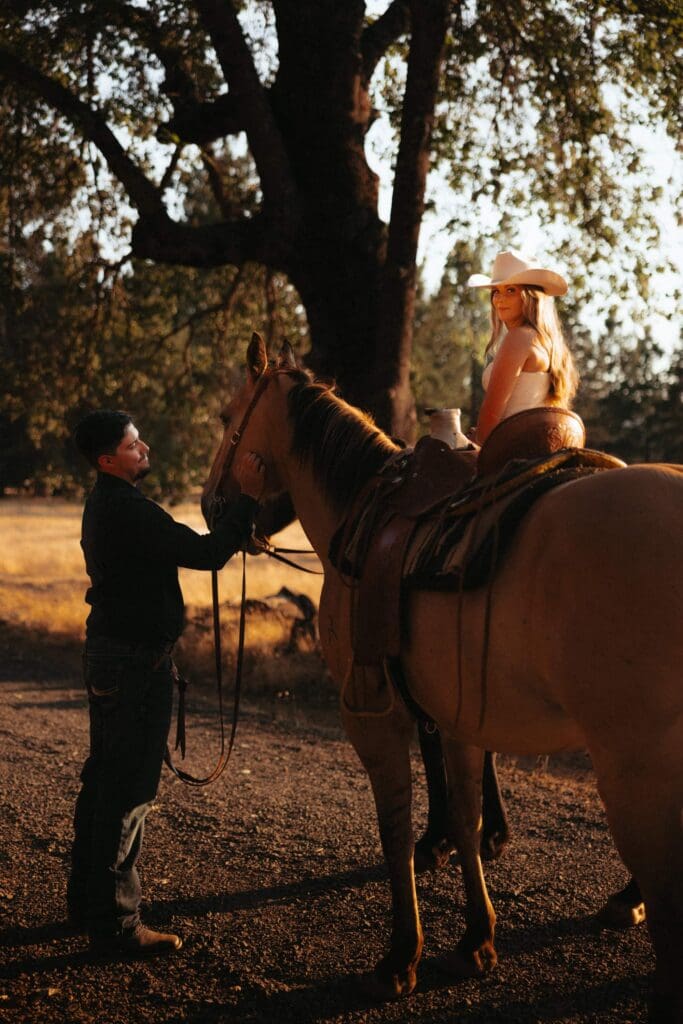
This really depends on what you want to do on your elopement days.
I’m an ideas gal and can work with whatever your budget is. Some couples keep things simple and let the landscape be the experience – some of the best adventures are free, after all.
If you’ve got a budget for guided excursions (horseback riding, flight tours, etc) those are an option, too.
How do you two most love to spend time together as a couple? What are you doing on your favorite memories? These are great places to start when it comes to thinking about how you’ll spend your wedding days.
Because what’s cooler than getting deep hang time with your hottest homie on the very days you commit to your next greatest adventure together?
Sounds like a dream to me.
Cost: The Bottom Line
A simple, two-person elopement with minimal logistics can stay relatively low-cost.
A more involved day with multiple locations, lodging in the park, or additional support will scale up accordingly.
Yosemite keeps the barrier to entry relatively low in terms of permits. The real investment is in how you choose to experience the place, not just accessing it. If you want help building a day like that, you can learn more about working together here.
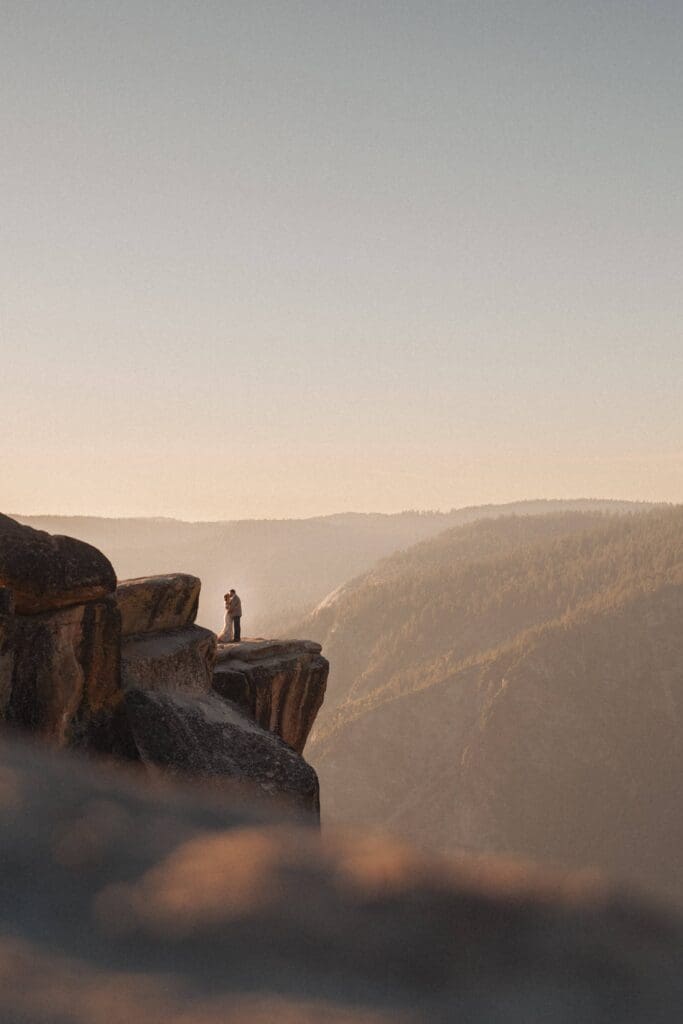
What are the Best Yosemite Elopement Locations?
Bottom Line: Yosemite houses an incredible diversity of landscapes, each with its own distinct feel. Valley floor, cliffside overlooks, alpine high country, old growth forest. The “best” location depends on what stirs your soul and fits logistically with how you want your day to feel.
Here’s a high-level overview of the classic Yosemite spots. For a more detailed breakdown, see my detailed location guide here: [COMING SOON].
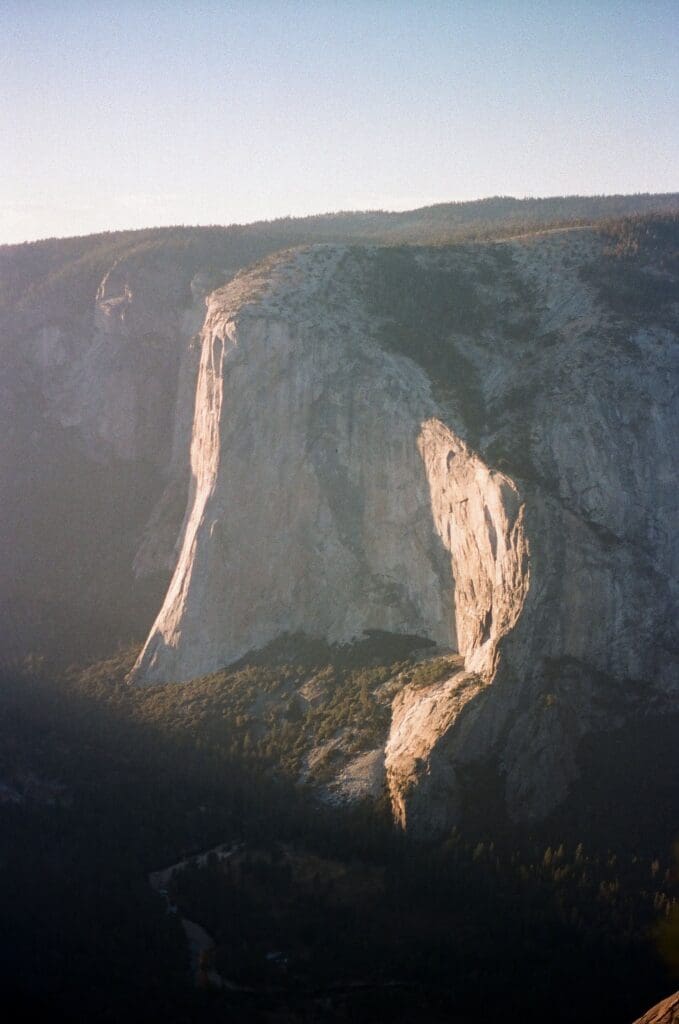
Taft Point
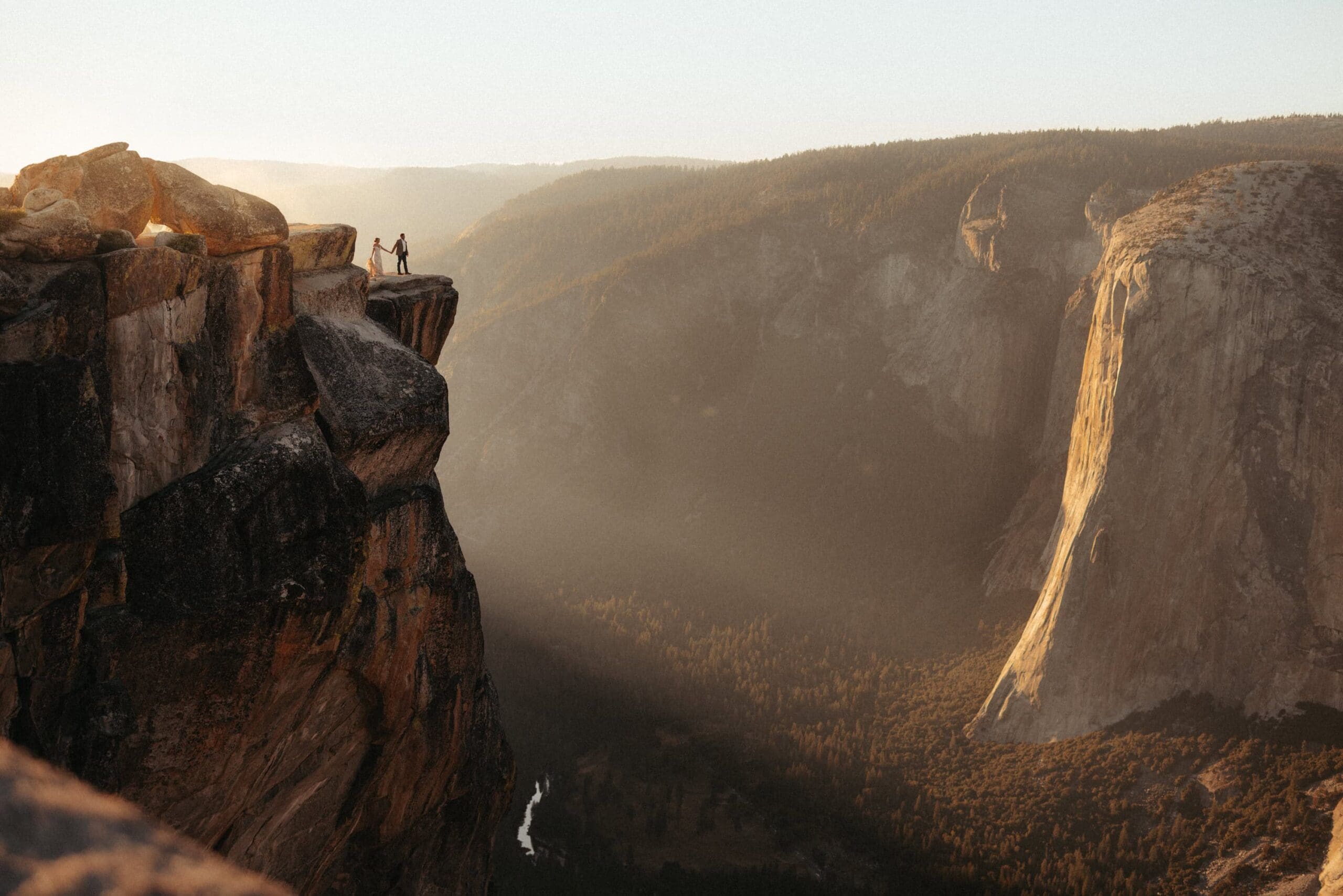
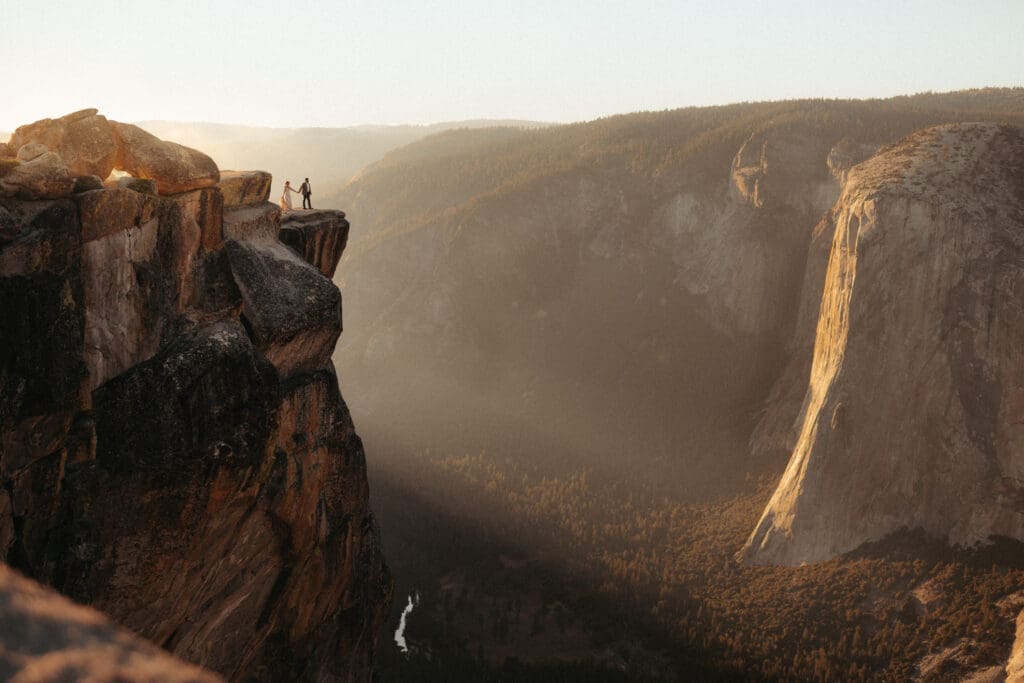
Sunset and Taft point, name a more iconic duo. Listen, this spot is incredible – and everyone knows it. You’ll no doubt be sharing this expansive viewpoint with other couples in their wedding finery (y’all can high five each other as you pass on trail!), so I don’t recommend the classic lookout point as a ceremony space if privacy is paramount (though we can get creative if you’re married to this view). But if you’re unphased by a (stunning!) easy 2 mile round trip hike through gorgeous sunlit forest, the payoff is unmatched for a viewpoint that is more like a religious experience than a lookout point. Glacier point road needs to be open to access the trailhead here and at Sentinel dome.
Sentinel Dome
Sentinel Dome is Taft’s quieter sibling, and a seriously underrated elopement location. Same general area, same access trailhead, similar kind of mega-view feeling, but way more private once you’re up there. Instead of standing at the edge looking out, you’re standing on top of the world with a full 360 view that includes Half Dome, El Capitan, Yosemite Falls, and the high country all at once. That makes this a great spot for both sunrise and sunset. You can move around, find your own pocket, and have a moment that feels like you’re on top of the world – likely, to yourself.
Glacier Point
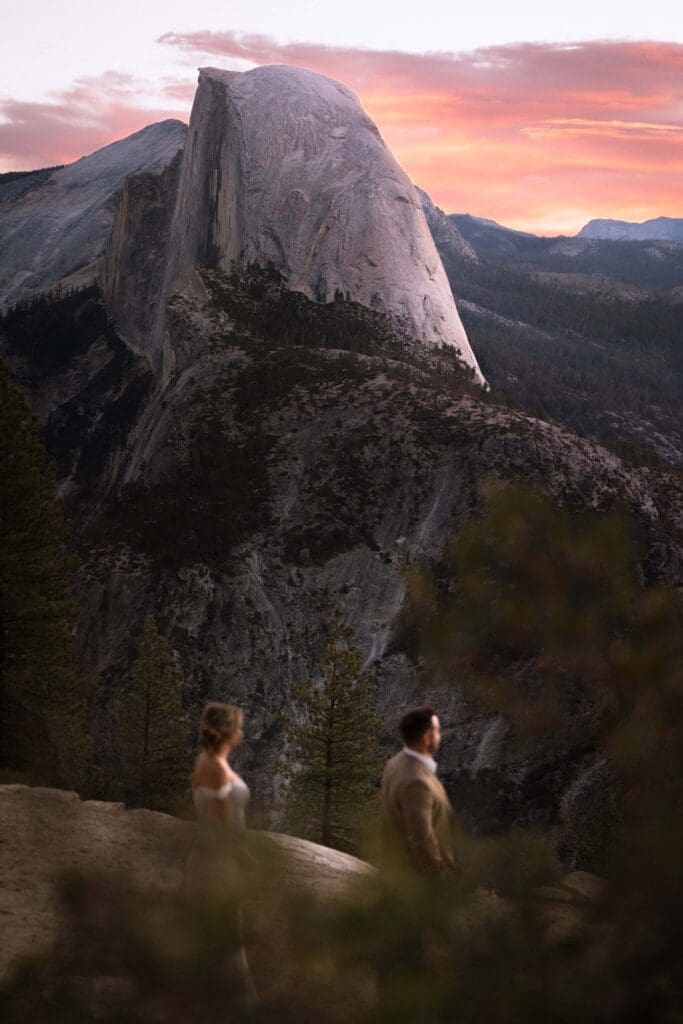
Glacier point is an unbelievable sunrise location, with panoramic views of the northeast end of the valley, North dome, and of course, what is probably the most incredible view of Half Dome in the park. When the road is open (late spring/summer/early fall), you can drive and it’s all just a short walk from the parking lot.
While it is incredibly accessible, that comes with a privacy and drive-time trade-off (the drive up can take 50 minutes to an hour depending on traffic / time of day). People do gather to see the sunrise here, but avoiding the crowds only takes a little creativity and know-how 😉 Alternatively, you can take a 9.6 mile walk up to the point in early spring before the road opens and have the entire place to yourself – I’m game, if you are!
El Cap Meadow + Cathedral Beach
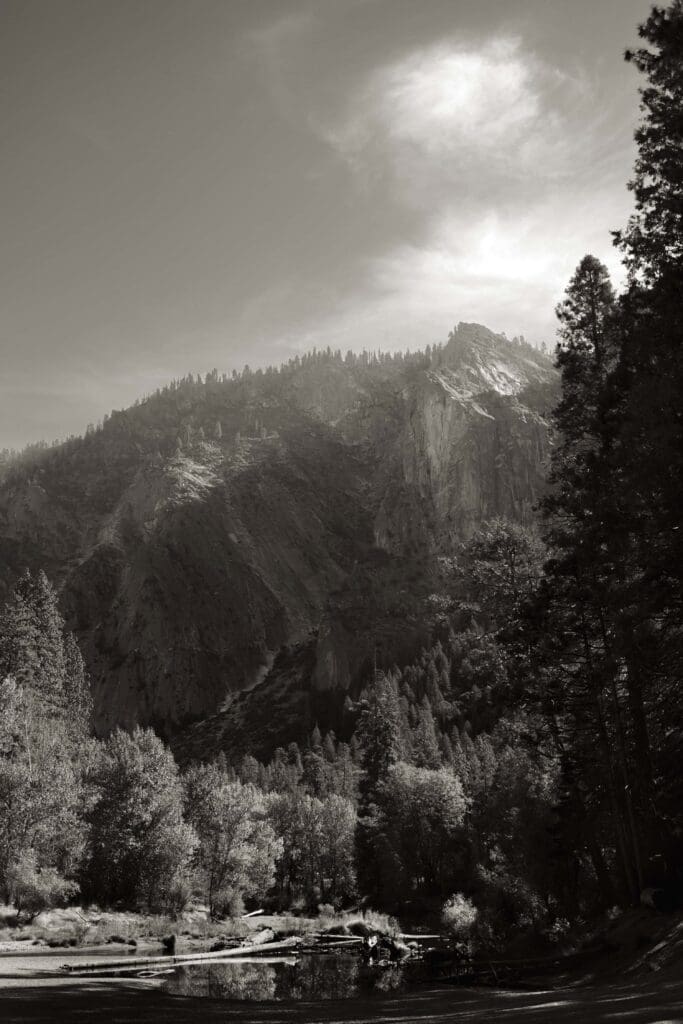
There is something grounding and holy about El Cap meadow. El Capitan is more than a mountain, it’s an entity, a character. When I worked in the park, I was told an Awahneechee legend about two little bears that slept upon a stone that grew so tall overnight, lifting them up to the sky. The only animal who was able to help them get down was the inchworm! So the people named the stone Tu-Tok-A-Nu-La, after the inchworm. Anyway, no amount of my writing can do justice to what it actually feels like to be beneath this mountain of bare rock and legend. El Cap meadow and Cathedral Beach are the places you go when you want slowness, reflection, stillness, and grounding (they are some of the quietest places in the valley).
Bridalveil Falls and Yosemite Falls
Water changes the energy of a place, and these two bring it in very different ways. Bridalveil Fall feels immediate. You hear it before you see it, and depending on the season, you might feel it too (you’ll get more than misted at Bridalveil in the Spring, but that could be a vibe!).
Yosemite Falls carries more distance and scale. It draws your eye up, way up, and gives you that vertical drama the Valley is known for. Both are iconic, both are heavily trafficked, and both reward early timing and a willingness to work with the flow of visitors rather than against it.
Tunnel View
Tunnel View is the place everyone recognizes, even if they don’t know the name. El Capitan on the left, Bridalveil Fall on the right, Half Dome in the distance. It’s the postcard view, and it draws a steady stream of visitors from pre-dawn through dusk. If you walk up to the main overlook, you will be sharing that space.
That said, with a little movement and some awareness of timing, it is entirely possible to find a pocket that feels quiet and your own, with the same sweeping view laid out in front of you. The experience shifts quickly to something intimate once you’re not standing shoulder to shoulder with a crowd. It’s one of those places where knowing exactly where to go makes all the difference.
Tuolumne Meadows + The Yosemite High Country
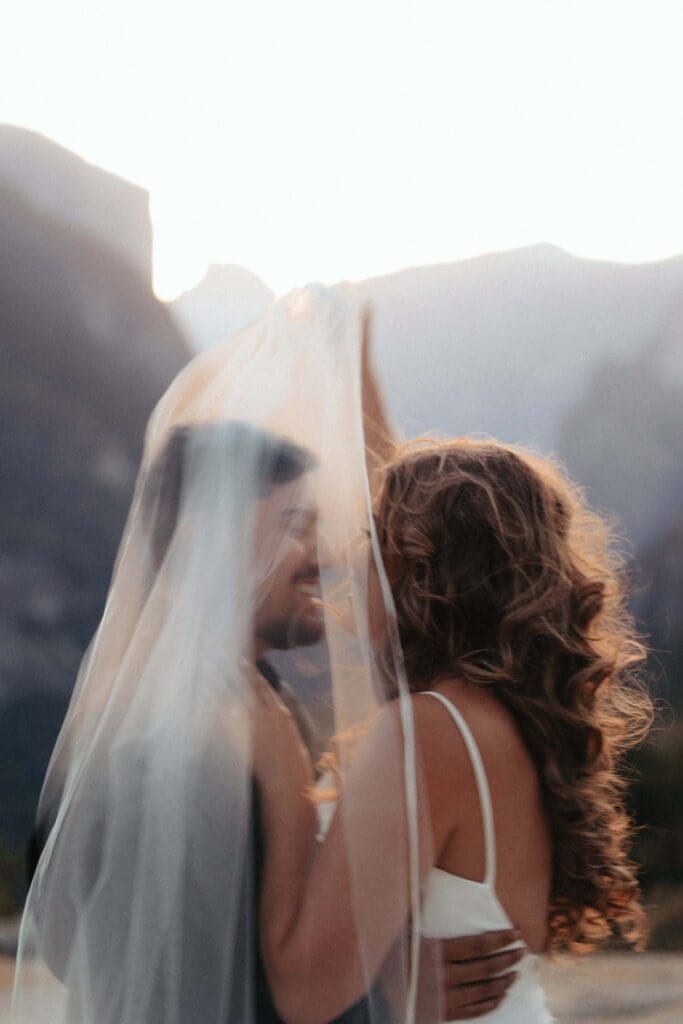
I always felt called to the high country. Fewer people, higher elevation adventure. There are so many places to go here, the possibilities are endless. Countless alpine lakes, exposed granite domes, and stunning meadows await elopement couples here.
Olmstead point is a breathtaking overlook with views of the back of Half Dome and lots of exposed granite to explore. I’ve found myself daydreaming of a Cathedral Peak elopement, if you want to earn your venue, so to speak. The high country is a drive up from the Valley, and is a more realistic objective if you’re already staying up in one of the high country lodges. Tioga Road typically opens late spring and closes with the first major snow.
Under-the-Radar Yosemite Gems
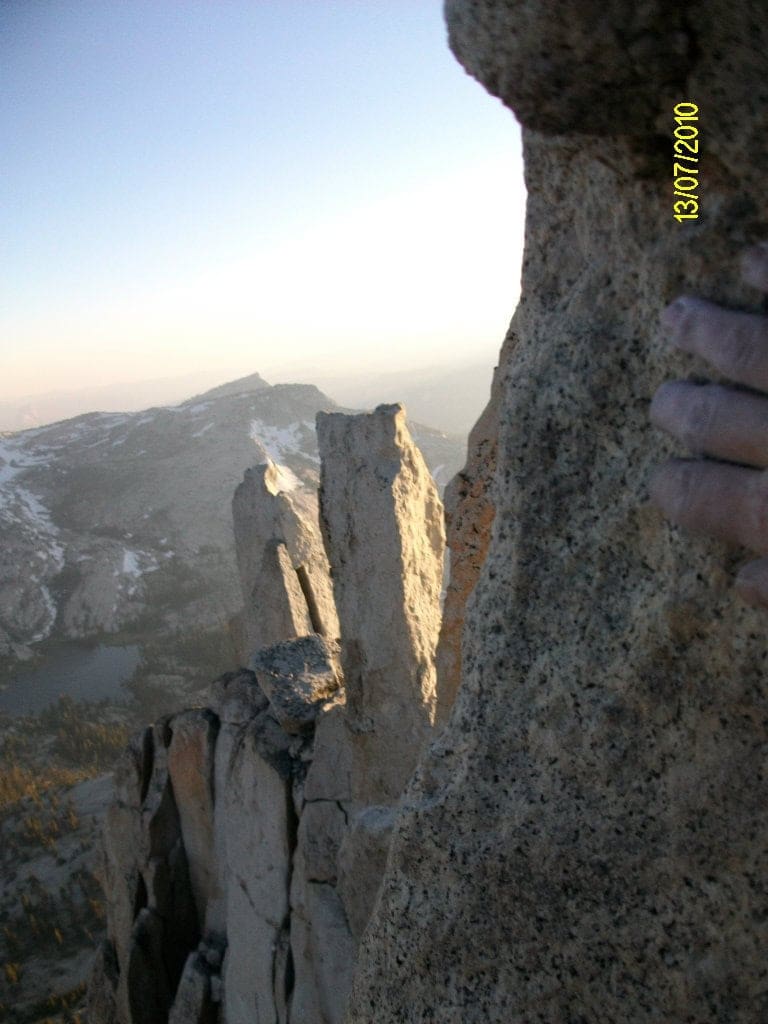
I don’t publish these spots, but they are plenty. Let’s go on an adventure 🙂
When to Elope in Yosemite: What Day of the Week and What Season?
Bottom Line: There’s not one, straightforward answer here – the “best” time for you is going to emerge from a cocktail of logistical and environmental factors as well as what you want when it comes to general vibe and things like crowds and environmental considerations.
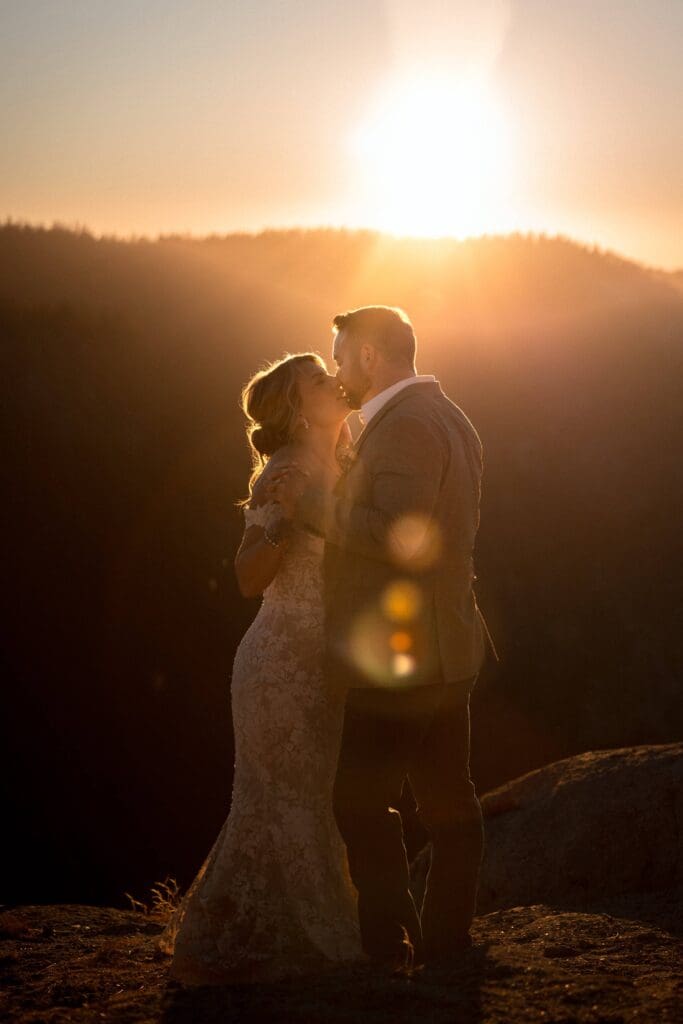
Do you want the vibrant color and crisp air of autumn, the roaring falls of spring, the still, snowy edge of winter, or the summer-camp vibes of peak season?
One timing piece that IS very straightforward is that weekdays – specifically Tuesday through Thursday – are the best days to elope in the park in terms of numbers of people on trail, easier parking, and less general congestion in park lodging and facilities.
I would not recommend attempting to elope in the park on a weekend, and it’s also important to know that ceremonies of any kind are not permitted in the park on holidays or during holiday weekends.
FALL | Incredible Color + Crisp Days
Fall elopements in the valley are That Girl. The October air comes in crisp and bright to break the heat, rains have doused the smoke, and the crowds are thinned out from their summer numbers. All roads are open, and the leaves are beginning to take color. It’s all the magic, without the unpredictability. For a Yosemite elopement that is the best balance of all possibilities, this is no doubt my favorite time of year.
WINTER | Stillness + Glittering Winter Wonderlands
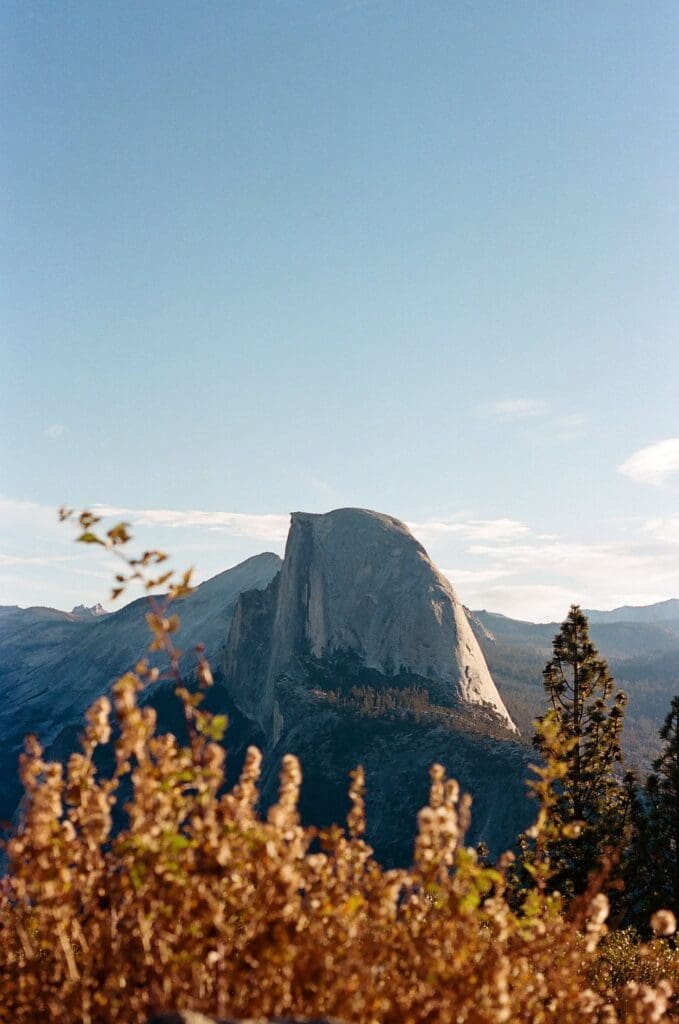
Winter Yosemite elopements are an incomparable experience. You have the valley all but to yourselves, and the stillness that settles there makes for an intimate experience you won’t get here at any other time of year. Early December is easily one of the quietest times in the park.
If seclusion at some of the valley floor’s most iconic spots is a priority for you, this is the time to do it. The tradeoff here is that you are limited to the Valley floor as both Tioga Pass and Glacier Point Road are both closed during the winter months typically starting in mid-November.
Snowstorms are also a consideration during this time as the park has closed before in the event of a major snow event, and tire chains are a blanket requirement for all vehicles when the roads require it.
SPRING | Waterfalls & Wildflowers
Spring in the valley is disney-fairytale level magic. The creatures of the valley are waking up, the waterfalls are roaring, wildflowers are blooming, greenery is returning, and the crowds haven’t descended just yet (April-May). The tradeoff here is that most of the roads that are closed in the winter months (you know, the ones that access those super cool up-high spots like Taft and Sentinel Dome) are still closed during the spring months.
To get an idea of when these roads open, check out the historical data on road openings in the park which they’ve logged since 1980. If you’re down for a Valley Floor elopement, few places beat Springtime Yosemite at golden hour, or just after a storm has passed through.
Summer | Summer Camp Vibes, Doable But Unpredictable
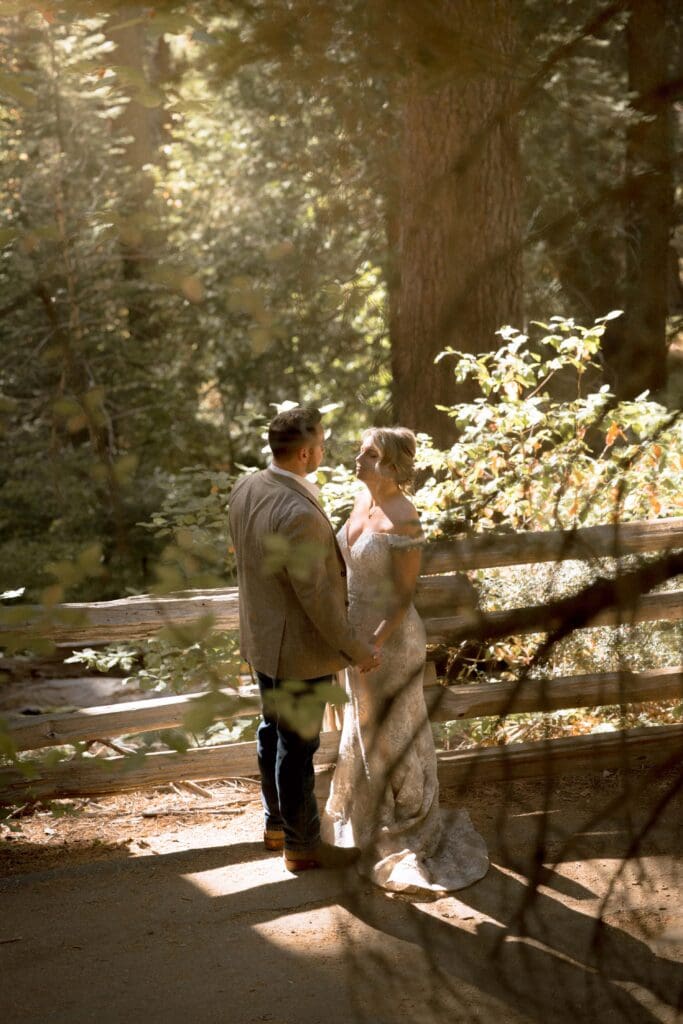
There’s two parts to the summer discussion – a high country Summer (Tuolumne) and a low country summer (the Valley). Summer in the Valley is mega summer camp vibes. Kids and families and climbers and backpackers and visitors from all over the world descend on the park to take in all the Valley has to offer. It’s not impossible to get away from the crowds, but it is harder. Other considerations include wildfire unpredictability, heavier traffic, and heat.
The long days and crowds require earlier starts, so manage expectations accordingly if summer is your window and you’ve set your heart on Yosemite Valley areas. The high country up in Tuolumne is an exception to most of this. There will still be some crowds, but it’s easier to get away from them and you’re more likely to beat the heat (staying up in the high country highly recommended for a high country elopement).
For multi-day elopements, a Tuolumne home base also opens up more of the eastern Sierra for additional adventuring. Regardless, wildfires remain a consideration no matter where you are in the area in the summertime. I’ve got a number of alternative locations for summertime elopements you might find interesting – check that guide out here: [COMING SOON]
Check out my Yosemite Month by Month guide here → [COMING SOON]
The Yosemite Privacy Playbook

It makes all the sense in the world to hope for privacy and a feeling of intimacy on your elopement day in Yosemite. After all, you’re not throwing a massive wedding for a reason. Most of the advice you will find on this topic can be distilled to “avoid crowds!” which is technically true …and functionally useless without any sense of how that actually plays out on the ground.
The reality is that privacy in Yosemite is almost always a byproduct of how we build your elopement day, not a feature of any single location. The same place can feel completely exposed or entirely yours depending on when you arrive, how long you stay, and what role that stop plays in the larger sequence of the day.
Most of the tension people feel with regards to privacy and crowds comes from trying to extract solitude from places designed to absorb millions of visitors a year. Since making people disappear is not in my particular book of spells, instead I help you shape a plan that gives us the best chance at the kind of solitude you seek.
Most Yosemite elopement days tend to fall into a handful of distinct patterns once you strip away the aesthetics and look at how the day actually functions. I think of these patterns as archetypes that ask for varying, but repeatable ways of structuring time, movement, and location based on what you want the day to feel like. Each one solves for privacy in a different way, with its own constraints and tradeoffs.
Here’s the playbook for these varying privacy preferences that gives you an idea of how we’d achieve different privacy goals for a Yosemite elopement or intimate wedding.
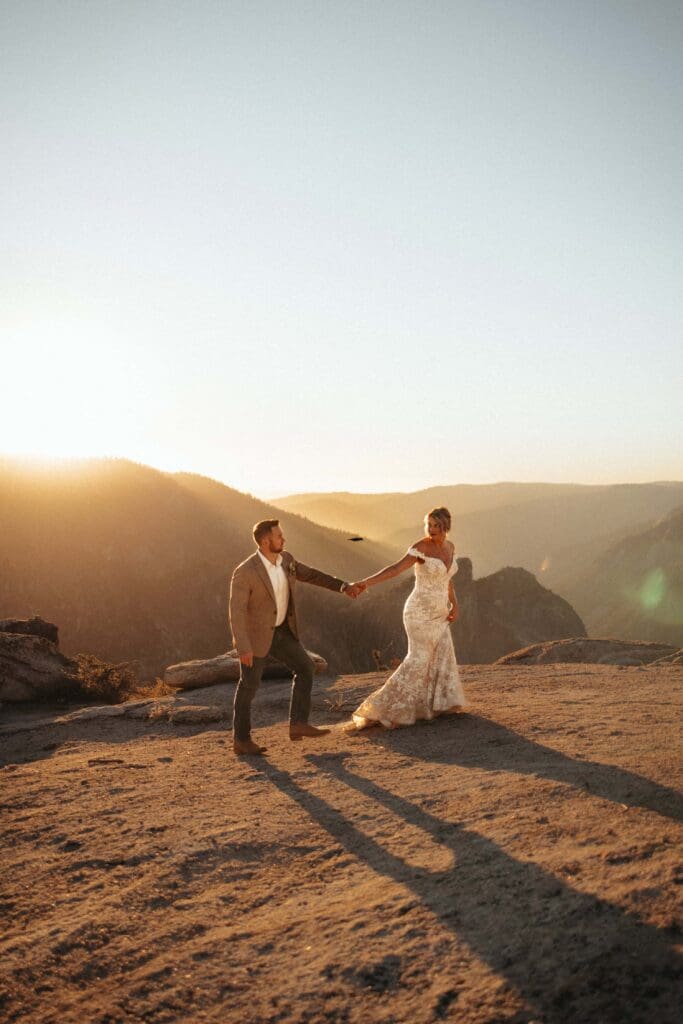
The Play; Iconic Centerstage Yosemite, With Crowds + Crowd Expectations Managed
WHAT IT FEELS LIKE
You’re standing in the very place you came for, taking in the view you’ve been dreaming about, and the sense of scale is even greater than you imagined. It feels familiar and new all at once. Other people exist in the periphery of the experience – friendly travelers congratulating you on trail, you swap high fives with other nearlyweds and newlyweds on location – but the folks about don’t define the experience and we find plenty of moments on our own as we make our way about these classic Yosemite locations.
HOW IT WORKS
Yes, we visit the well-known overlooks, but then we move to anchor the unfolding morning to a quieter, lesser known sublocation. Tunnel View, Glacier Point, similar high-traffic viewpoints all fall into this category.
Weekday and shoulder-season timing does the heavy lift in terms of managing crowds, especially Tuesday through Thursday when the park moves a little slower. For sunrises, we arrive well before first light in order to experience the quiet twilight in these locations before the crowds land. The need for extreme early starts softens outside of peak season, though sunrise still offers the most consistent privacy window.
For sunset, we might choose a quieter first location for getting ready or reading vows to create a baseline of connectedness and intimacy. The iconic sunset stop comes after, with a shorter window and a clear exit before the parking lot turns over.
Positioning and duration do most of the work. A few minutes beyond the obvious stopping points changes the density of people around you. Keeping the stops at the “main event” spots concise prevents the experience from feeling defined by the presence of other people.
TRADEOFFS
These locations are visible and remain active throughout the day. Privacy comes from how exposure is limited, not from removing it entirely.
WHO IT’S FOR
Couples who want Yosemite to look unmistakably like classic, Ansel-Adams Yosemite and are comfortable sharing space briefly in exchange for that feeling and those visuals.
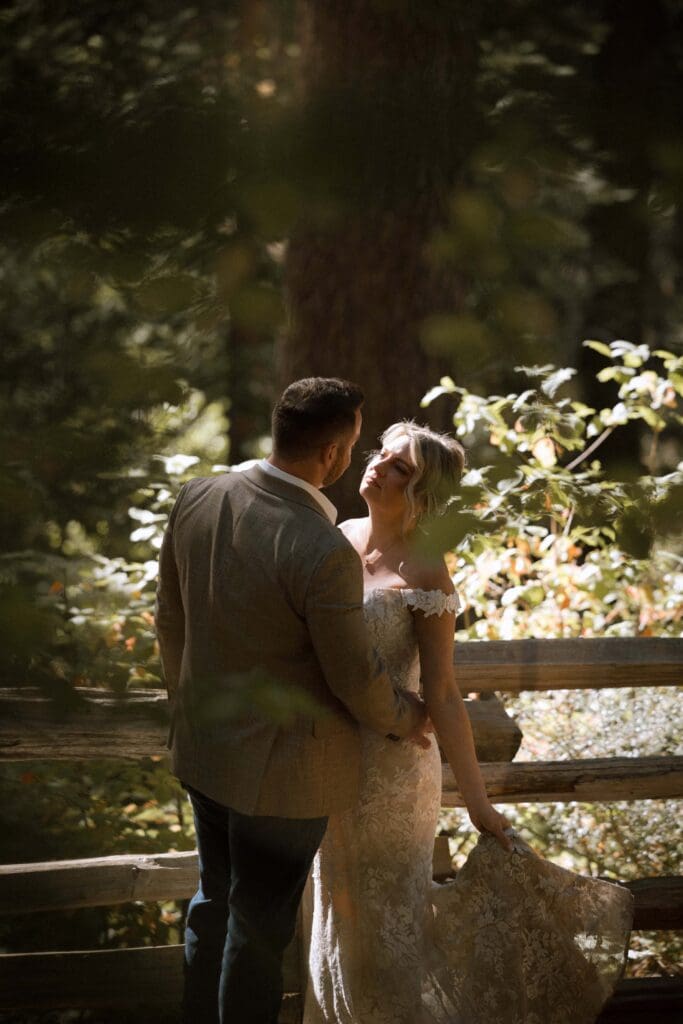
The Play: Tranquil Yosemite
WHAT IT FEELS LIKE
The same landscapes, more stillness (even an abundance of stillness), with a seasonal strategy.
HOW IT WORKS
We let the macro seasonal patterns drive our timing. Deeeeeep autumn, early winter, and very early spring reduce overall visitation in the Valley, which makes even the most iconic valley locations feel stiller and more serene. Winter snow in particular opens up space on the valley floor that is difficult to access in other seasons.
The day itself tends to simplify – fewer driving and road logistics, more focus on a few close-together (relatively) spots on the valley floor. The need for extreme early starts softens outside of the long-day seasons. Sunrise still offers the most consistent privacy window.
TRADEOFFS
Access narrows as roads close for the winter, limiting locations to the valley, and weather becomes a more active variable. We’re working with snow, storms, and shorter daylight hours.
WHO IT’S FOR
Couples who want the familiarity of Yosemite Valley’s most recognizable places, but want them quiet, still, with a willingness to let the character of winter shape the experience.
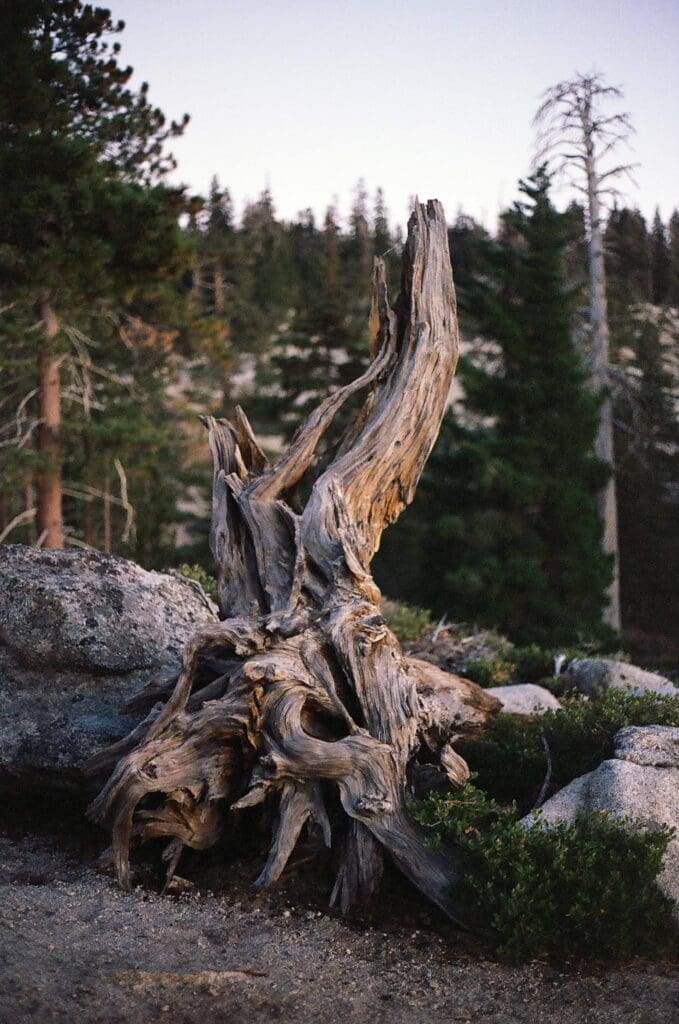
The Play: Quiet Yosemite Wilderness
WHAT IT FEELS LIKE
You’re getting to experience a side of Yosemite people rarely see. You’re enjoying lesser known areas of the park, taking in unexpected viewpoints, and enjoying more privacy than you otherwise would have at the classic locations.
HOW IT WORKS
We don’t anchor the day in the classic locations, but instead opt for nearby alternatives that capture a different, but adjacent, character as the iconic postcard spots. These locations are quieter, easier to wander alone, with plenty of room to breathe. Iconic stops, if we plan them at all, tend to feel more like “bonuses” to the day rather than the centerpiece.
TRADEOFFS
The most recognizable viewpoints play a reduced role or appear in alternative ways. The experience prioritizes atmosphere and privacy over specific landmark moments.
WHO IT’S FOR
Couples who care equally about the day feeling quiet and uninterrupted and still want exploration of Yosemite’s roads-less-traveled (in AND out of the Valley) to play a part in their day.
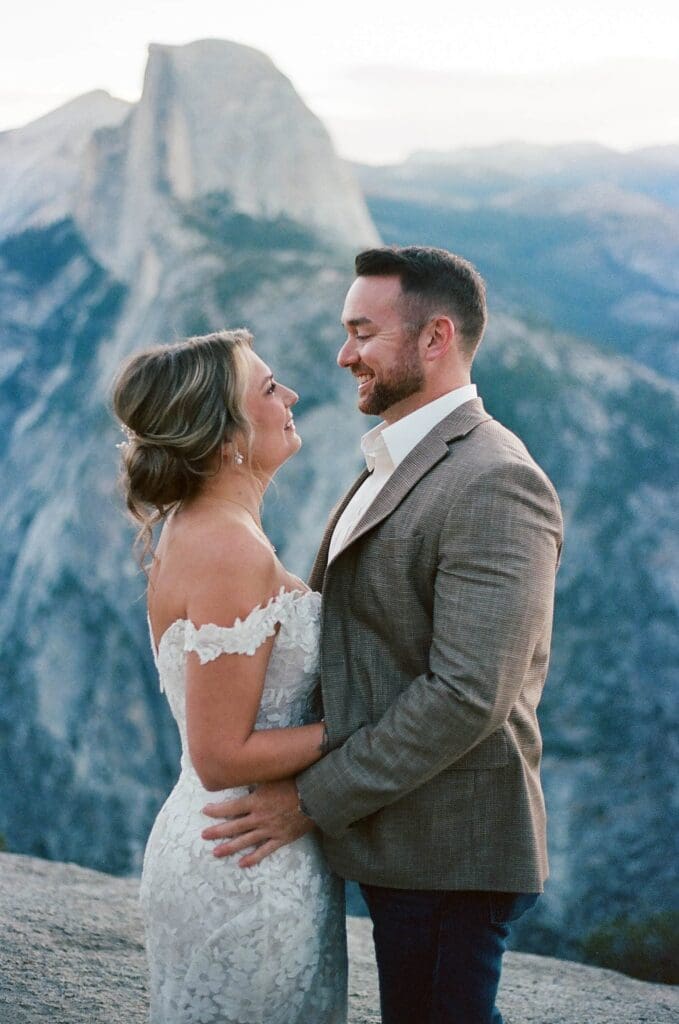
The Play: Guest Friendly Yosemite AND “Just Us” Time
WHAT IT FEELS LIKE
The day begins with structure, ease of access, and the ability to share some of Yosemite’s best known landmarks with loved ones. Guests feel taken care of, and the experience still leaves room for privacy after the ceremony / post-ceremony picnic / etc.
HOW IT WORKS
This approach separates the guest experience from the private experience, rather than trying to combine them into a single location or moment. Midweek and shoulder season timing eases the logistical load significantly.
The day often begins with a sunrise ceremony at a site with straightforward access and easy parking. The couple arrives early, ahead of guests and crowds, to take in the sunrise in a space alone near the ceremony site. Guests arrive, and the ceremony takes place with a magnificent backdrop. From there, guests and the couple might transition to a quieter space for perhaps a picnic, family photos, and celebration together.
Note: formal receptions – the kind with seating, catering, amplified music, etc – are not permitted in Yosemite. But a group of guests could use a designated picnic area and eat together. These areas are first-come, first-served, so having members of the party snag tables would be important. Alternatively, having guests pack-their-own picnic basket for an informal meadow picnic is also a way to handle this for smaller groups.
After a mid-day siesta or daytime activity, we meet again – just the newlyweds – for a quiet sunset, taking in the joys of the day in a more private location.
TRADEOFFS
Privacy during the ceremony itself is more limited, as they happen at more popular, designated ceremony sites, and there will likely be people about in ceremony locations that allow for a higher guest count. But in my experience the vast majority of people are respectful and give space in totally reasonable ways. The quieter portions of the day for the couple happen later, once the group has dispersed.
WHO IT’S FOR
Couples who would like to include family and friends while still preserving time and space for themselves.
The Play: Full-On Adventure Yosemite
WHAT IT FEELS LIKE
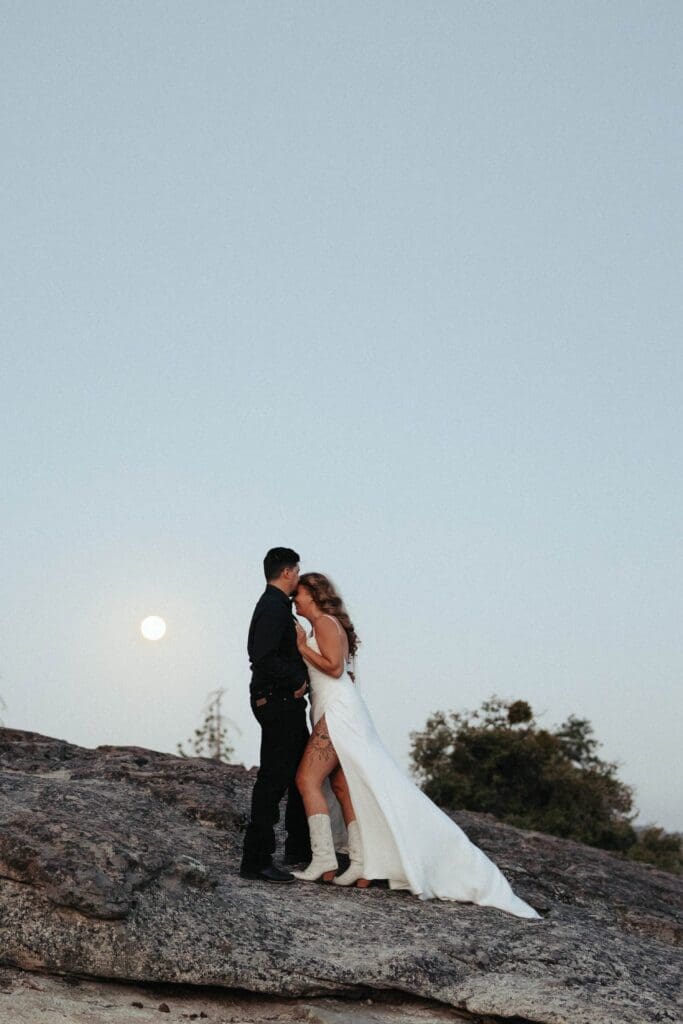
Distance and effort create an incredible payoff in terms of privacy and access to unique Yosemite wilderness. It’s you, your beloved, the feeling of effort in your body, and the release and high that comes from a well-earned view. Only, at this summit, you get to walk away married <3
HOW IT WORKS
We get creative and apply elbow grease when the roads are closed. Maybe we hike the 5 miles up to Glacier or Taft Point in mid-April, when the trail is open but the road is still closed so we can have it all to ourselves. Or perhaps we do a deep autumn hike up to lower Yosemite falls. Once at the top of wherever we’re going, we take a beat, refresh, get ready, and enjoy a ceremony timed to the light of dawn, alone in a space that almost never grants that level of access and privacy.
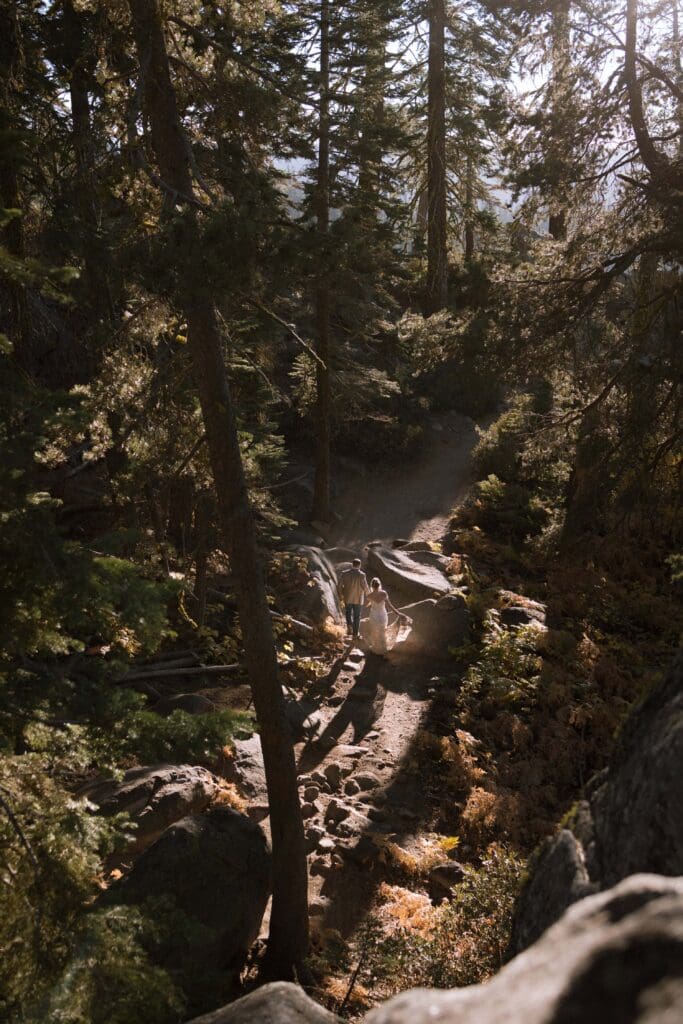
The hike down (in wedding finery, if you wish! It’s actually so fun!) becomes a part of the experience rather than an afterthought – we pause to take in the views, portraits, basking in the glow of being newly wedded and on a true adventure. Because we’re doing this in the off season, we can then head to a more iconic Valley spot to put a bow on the experience with something more relaxed.
TRADEOFFS
This approach requires more physical effort and flexibility. Conditions can change quickly, and, like any good adventure, preparedness is essential.
WHO IT’S FOR
This is for the earn-your-turns crowd. The seasoned outdoorists who want their wedding day to feel like the adventures you’re used to. These couples want the physical experience of Yosemite to be a part of their wedding story and are comfortable building the plan around an endeavor.
Fun Elopement Activity Ideas: Ways to hang with your hottest homie
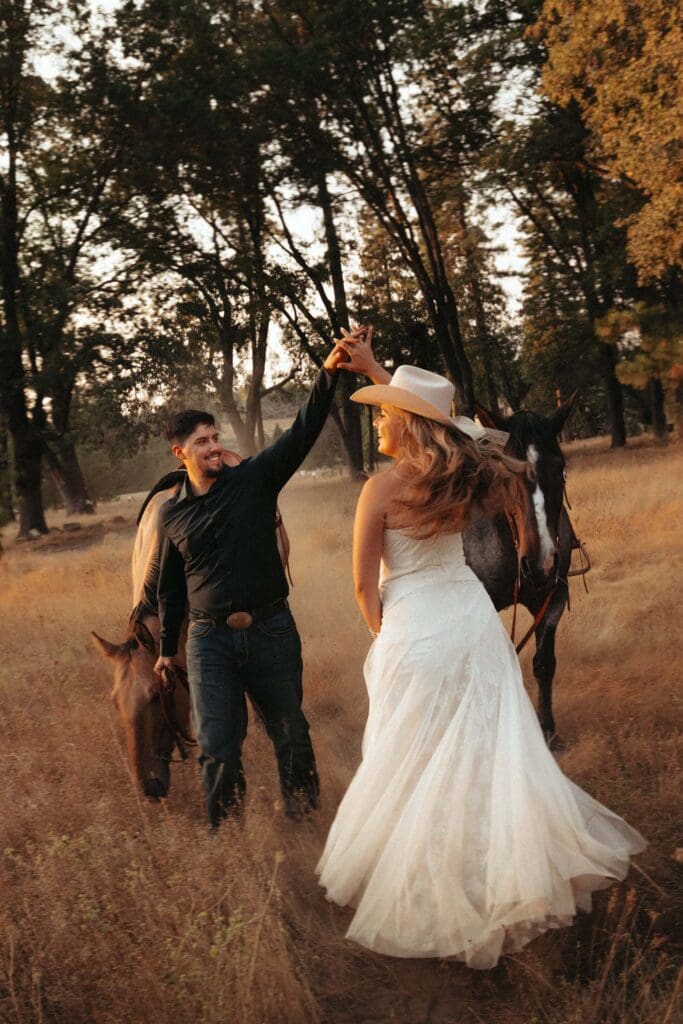
Hot take: you should have time to hang out with your hottest homie on your wedding day. So instead of having a massive wedding where you’re caught in a whirlwind entertaining others all day and later wishing you could live the day over in slow motion, why not just… live the day in slow motion? With the person this whole thing is about? Though I guess if you’re reading this, you probably already agree with me 😉
So besides for hiking (Yosemite has 800 miles of maintained trails with over 300 trails listed in AllTrails!), what are some fun ways to play in Yosemite?
- SUP, Kayak or raft the Merced through the valley
- Take a guided horseback ride
- Go birdwatching to see any of the 165 species of birds that call Yosemite home
- Rent bikes and see the sights on 2 wheels
- Have afternoon tea at the historic Ahwahnee dining room
- Take a rock climbing class with Yosemite’s legendary Climbing School
- Find a place to post up and paint together with mini watercolor kits
- Stargaze with cosy blankets in El Cap Meadow (I’ve got a small telescope, if you ask, I’ll bring it along!)
- Go for a swim and beach lounge on one of the river beaches
- Have dinner and drinks at the Mountain Room
- Do a retro disposable camera photo scavenger hunt
- Play a favorite game at your secluded airbnb
- Take a bubble bath or hot tub soak
- Take a Yosemite Air Tour
- Pack your favorite snacks and picnic somewhere incredible
- Go backpacking for a night
There are probably a dozen more ideas to add here based off your own ideas and lore. Go on a date night and let me know what you and your betrothed come up with!
Where to Stay in + Near Yosemite National Park
Bottom Line: Where you stay determines the entire rhythm of your time in Yosemite. It determines how early you need to move, how much driving you’re doing in the dark (Valley traffic in busy seasons can be a LOT), and how much space you have to actually be together in the middle of it all. I think about lodging less as a place to sleep and more as part of the experience you’re building.
Private Cabins (Airbnbs, VRBO, etc)
If privacy matters, this is the move.
Yosemite West is the area I recommend most often because sits inside the park boundaries, which simplifies access and cuts way down on drive time into the valley and surrounding areas. Yosemite West also positions you right off Glacier Point Road when it’s open, which makes sunrise access to Taft Point, Sentinel Dome, and Glacier Point far more workable.
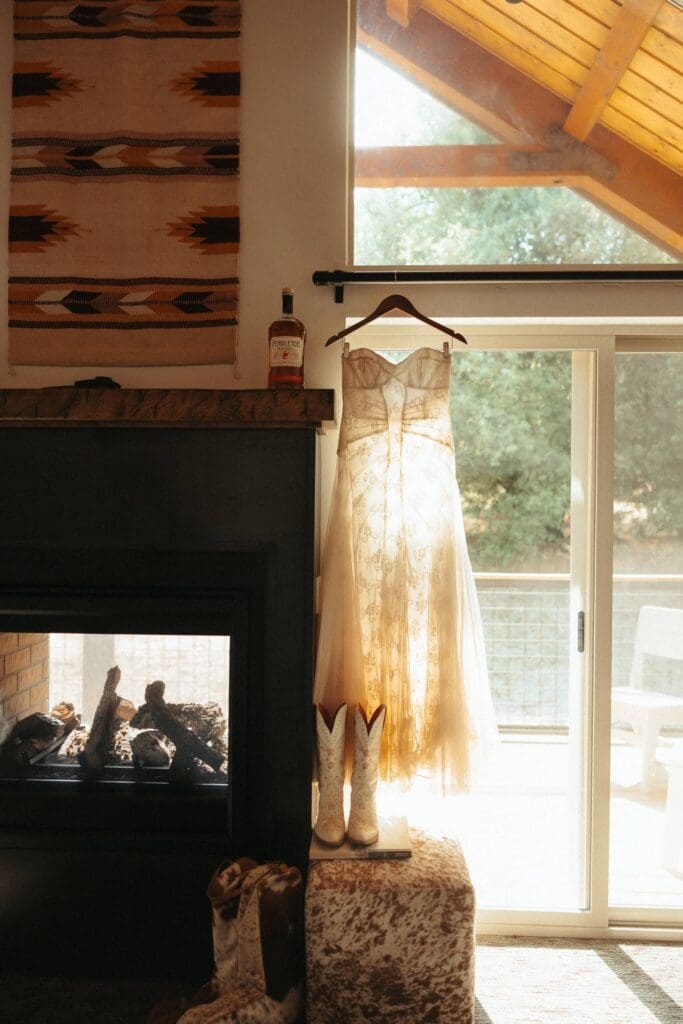
Cabins also give you a really nice landing place. You can cook, spread out your gear, have a slow morning, take a breath between locations. Some of these cabins have gorgeous balconies, hot tubs, and views, and are an experience in and of themselves. For multi day elopements, that matters more than people expect.
Outside the park, towns like El Portal, Groveland, and Oakhurst open up more options and often better pricing. The tradeoff is drive time. In peak season, that drive can stretch longer than google maps can predict.
AutoCamp Yosemite
AutoCamp sits just outside the park near Midpines and features airstreams, modern cabins, clean design, and easy logistics. It works well if you want something styled and straightforward without going fully into a private rental. It’s also one of the easier options for groups or guests. And I don’t know about you, but I’m obsessed with the Airstream aesthetic.
Staying Inside the Park
There is something so special about waking up right in the Valley. The scale and light hit different when you’re right there in it. The tradeoff is cost, availability, and a little less control over your environment.
The Ahwahnee
This is the historic centerpiece of Yosemite lodging. Massive stone architecture, high ceilings, a sense of place that feels tied to the history of the park. If you want a slower, more anchored experience, this delivers. It also places you directly in the Valley, which simplifies everything logistically.
Yosemite Valley Lodge
More practical, still well positioned. It sits right near Yosemite Falls, which means you’re close to some of the most accessible Valley locations. This is often the most balanced option inside the park in terms of cost, comfort, and location.
Tuolumne Meadows Lodge
High country, completely different energy. Fewer people, higher elevation, more space. This only works when Tioga Road is open, but if you’re planning anything in the high country, staying up there changes the entire feel of the experience (and is quite frankly just necessary in terms of timing if your elopement is taking place up there). ]
Valley Glamping and Canvas Options
For true summer camp vibes, immersion, and proximity.
Curry Village
Canvas tents and cabins right in the Valley. You hear the river, you see Half Dome when you step outside. It’s social, active, and very much part of the Yosemite ecosystem. Not quiet, but deeply atmospheric. And close to my heart – during my time living in the valley, I lived right next to Curry Village.
Housekeeping Camp
Open air concrete structures along the river. Think of it as structured camping. You bring your own setup, cook your own food, and live close to the landscape. It’s one of the most tactile ways to experience the Valley.
Campgrounds (Bring Your Own Setup)
If you want Yosemite in its most direct, essential form, this is it. No buffer, no insulation, just you and the Valley doing its thing around you. All my core memories of Yosemite in childhood were spent at the campgrounds.
North Pines, Upper Pines, and Lower Pines are the core Valley campgrounds. They sit right along the Merced River, tucked beneath granite walls that make it impossible to forget where you are for even a second. You wake up with the light hitting the cliffs, fall asleep to the sound of the river, and spend the in between hours fully inside the landscape. The smell of campfires and the sounds of children and friends laughing will envelop you here.
North Pines is the most sought after. It’s quieter, more tucked into the trees, and many sites sit directly along the river. Upper Pines is the largest and easiest to access year round, which makes it the most consistently available, relatively speaking. Lower Pines is smaller and seasonal, but well positioned.
This is not a casual booking process. Reservations are competitive and release in blocks on a rolling schedule. Sites often get claimed within minutes, especially for peak season. If this is important to you, you need to plan ahead and be ready when reservations open.
There are tradeoffs. You’re sharing space with other campers. You’re working within campground rules. You’re bringing and managing your own gear. Weather matters more. Comfort is what you make it.
But if camping is a comfort place for you as a couple and your goal is to have the full-on national park experience, this can be a great time.
A Thought on How to Choose
This comes down to what you want your time to feel like. If you want the experience to feel luxurious, and to have space, quiet, and flexibility, I highly recommend a private cabin.
If you want immersion and proximity, more of a full-on “national park” experience, and are okay with what that entails traffic-wise in busier seasons, stay inside the park. And if you’re building part of your day around the high country, stay up there.
Most of the friction people report feeling in Yosemite comes from underestimating how much movement the park requires and what visitor volume can do to ease of movement. Where you stay either compounds that or softens it.
Choose the option that gives you the vibe you’re looking for and the most room to move through the park the way you actually want to.
What to Bring for Your Yosemite Elopement
What you need to bring to support your day is going to depend a lot on the kind of day you have planned, and what season you’re in, but here’s a basic overview of things you will probably want to have on an elopement day in Yosemite!
Wedding-Logistics Specific Things
- Marriage license + ID
- Permit confirmation (printed and offline copy)
- Officiant details and contact (if that’s me, just bring me!)
- Rings
- Vows (printed, not just on your phone)
- Any letters or gifts or sentimental items for ceremony
- Champagne 😉
- Bouquet and florals and supplies for transporting florals/keeping them fresh
- Timeline or plan for the day (I’ll provide this for you!)
- InReach if you want to be absolutely certain you’ll be able to make contact with essential people (I have one, they’re honestly great to have if you frequent the outdoors!) Cell service is unreliable to nonexistent in most of the park.
Elopement Clothing and Layers
- Wedding ‘fits (yes, you absolutely can hike in that dress, and yes, it’ll look great with an ombre at the bottom of the hem) 🙂
- Insulating layer (synthetic insulative layers are great)
- Weather layer (windproof or waterproof shell), even if the forecast is clear. Yosemite weather swings can be extreme within a single day, especially between Valley floor and higher elevation.
- Comfortable hiking shoes or boots
- Backup footwear if desired (people love doing photos in their hiking boots! But if you want something else for photos, make sure you bring it along)
- Wool socks
- Gloves and hat if shoulder season or alpine
- Change of base layer if at any point it’s time for the wedding finery to come off!
Outdoor Essentials
- At least 2.5-3 liters of water per person, more for longer days
- Electrolytes
- Easy snacks you’ll actually eat
- Something more substantial if you’re out for hours
- Sunscreen
- Sunglasses
- Bug spray (just use the DEET. Trust me)
- Chapstick
- Headlamp
- Bandana
This baseline list is built on years of backcountry experience in the Sierras. If you want a more detailed discussion of what packing for an elopement looks like, as well as my wilderness-tested specific gear recommendations, head over to my packing discussion here → [COMING SOON]
Yosemite Elopements: What Can Go Wrong
I want to address these concerns up front because these are common things you hear about on message boards and sometimes in casual conversation about National Park weddings. What I don’t want is for you to feel like you’re the only one carrying these concerns – this is one of the most important days of your life, and you should know that the person you’re planning it with has got your back when it comes to anticipating and planning for these contingencies.
It is 100% true that navigating park lands demands preparedness and flexibility from all parties. But the truth is, most issues aren’t dramatic in the cinematic sense (park closures are the exception, not the baseline, even in this political climate). Most of these issues are a matter of friction, and are logistical, predictable, and manageable if you plan for them.
Wildfire Smoke
Wildfire smoke is not a rare, freak occurrence – the park itself will tell you that Yosemite is a fire-adapted ecosystem and that wildfire smoke is as much a part of that ecosystem as water and ice. You can avoid and mitigate smoke risk by planning your elopement outside of the hottest, driest months. Late summer and early fall carry real risk in terms of wildfire and wildfire smoke, and this is why summer is typically my last recommendation when it comes to elopement timing in Yosemite. Air quality can shift quickly, even if fires are not in the immediate area. Visibility drops, light changes, breathing gets harder. The park keeps an air quality dashboard updated here. If you do choose a summer elopement in Yosemite, do so with the working assumption that you need to have a flexible plan. That can mean shifting time of day, moving to a different part of the park, or pivoting locations entirely.
Road Closures
Tioga Road and Glacier Point Road close seasonally, so this is a routine variable when it comes to planning elopements in Yosemite. These closures happens on a fairly regular rhythm (see the historical data here!) with the caveat that, years with enormous snowpacks, late season weather, freak storms, rockfall, and infrastructure repair can also shut down road access either for longer or with little notice (you can find information on current conditions and closures here). The fact is that if a road is closed, there is no workaround, unless you choose to hike (which can be a great adventure, but one you do not want to go into unprepared). You need to know what your plan depends on and what your alternatives are.
Permit Delays
The permit office runs on its own timeline. Processing can take weeks, and last minute submissions create pressure you don’t need. The simple fix here is to apply early, follow instructions exactly, and build in buffer time. I am here to walk you through the process so it feels easy and seamless!
No Cell Service
Most of the park has little to no reception, and depending on where you are, messages don’t send, maps don’t load, and calls fail. You should assume that once you enter the park, you are offline (even though you can find bits of service here and there). If traveling with guests, set meeting points, download maps, and don’t rely on real time communication. I have an InReach device that I use to communicate via satellite and for emergency purposes.
Missed Meetups
This is usually a downstream effect of the above. One person hits traffic, another loses service, timing slips. This is why I define exact locations with GPS coordinates, not general areas or pins that often have duplicates on Google Maps. If you have guests attending your wedding, I can help you with these locations so that you and your guests are on the same page about where things are happening.
Parking Headaches
Build in enough time to find parking – guests, especially, need to know this and to leave earlier than they think when it comes to driving over and up to popular areas.
Park Closures
The truth is, full or near-full park closures do happen, but they are the exception, not the baseline. In recent official examples, Yosemite closed to visitors in March 2020 during the pandemic, was closed during that historically heavy winter storm cycle in March 2023 (do y’all remember that? Pepperidge farm remembers that. I didn’t see the ground here in the Sierras for seven months!), and again posted storm-related safety closures in February 2026 after infrastructure damage from a major snow event. Government shutdowns typically don’t shut the park down fully – during the most recent 2025 shutdown, the park was still open, just unstaffed. Those are real risks, but they are episodic rather than the day to day norm.
The Bottom Line
Most things that go wrong in Yosemite are not dramatic park-shutdown scenarios. They are usually friction points: a road opens later than hoped, smoke changes the air and visibility, or a storm changes road or facility access. Full closures do happen, but they are the exception. Seasonal road closures and changing conditions are the much more common planning reality.
In the event that Yosemite does fully close or conditions make your plan unworkable, we pivot. That might mean shifting to a different part of the park, adjusting timing, or moving to a nearby location in the Sierra (my home territory!). I always build plans with contingencies and flexibility in mind so that you’re not starting from zero if something changes.
How to find the best photographer for your Yosemite elopement
There are plenty of people out there who are competent with a camera, and who can competently plan you a great day. The question is, who do you truly connect with? And what is it you want out of that connection? It’s a question only you can answer.
When I think about how you ended up here on this page, I’m not just thinking about the decisions you’re making about your elopement.
I’m curious about everything that led you here, to this moment in your life. I’m curious about the parts of your lore you hold dearest, the parts of your story that make you belly laugh the deepest, and the tender places that finally have a soft landing place because you and your partner, at last, found each other.
Your elopement day is about so much more than this individual day. I want to know the story that brought you here, and I want to know the story you hope to write as you go on, and from there architect an experience that leaves you with a constellation of memories to guide you forth on all of your next greatest adventures, together.
That’s the training talking, honestly. I spent years close-reading stories for a living, and now I do it with couples, and the day I build comes straight out of yours.
If you want to plan this day with someone who will take the time to learn who you both actually are,
If you want someone who can help you shape a wedding day out of the real stories of your life,
And if you want someone on your elopement day who will not only create photographs that show how the day felt, but who will also hold the weight of the moment with you,
Then I’m here.
No matter how you ended up here on this page, I’m glad you’re here, and I’m happy to have helped you in some way along your elopement planning journey. Whether you’re reading this and sold on Yosemite or still thinking of other magical places you could cross this threshold, I would love to keep being of service!
Ready to learn more? Sign up for your free curiosity call today → REACH OUT
FREQUENTLY ∿ ASKED ∿ QUESTIONS
Do I need a permit to elope in Yosemite?
Yes, you need a Special Use Permit from the National Park Service to legally elope in Yosemite. If you are having any kind of ceremony in the park, you need a permit. The application fee is currently $150 and submitted by mail. Guest count affects where you can hold your ceremony and whether a ranger monitor is required, but it does not remove the permit requirement.
How many guests are allowed?
Yosemite allows small elopements, but guest count determines which ceremony locations you can use. Groups over 10 are restricted to designated ceremony sites. Smaller groups have more flexibility as long as Leave No Trace practices are followed. The practical takeaway is that Yosemite supports both guest-free elopements and small gatherings, but scale changes your options.
Where can we legally have our ceremony?
You can only hold your ceremony in approved locations in Yosemite based on your group size. Meadows, sensitive areas, and certain high-impact locations are off-limits regardless of group size. Approved locations depend on your guest count and current park regulations. This is one of the areas where working with someone who knows the system matters.
What is the best time of year to elope in Yosemite?
The best time to elope in Yosemite depends on your priorities for weather, access, and crowd levels.
- Fall offers balanced conditions with fewer crowds and full road access
- Winter offers the most solitude but limits you to the Valley floor
- Spring brings waterfalls and wildflowers with partial road closures
- Summer has full access but higher crowds, heat, and wildfire risk
If you want a simple rule: weekdays, especially Tuesday through Thursday, consistently offer a better experience than weekends.
Can we bring our dog?
No, dogs are (tragically) not allowed at wedding ceremonies in Yosemite. Pets are not permitted at ceremony locations within the park. If you’d like to incorporate your beloved hound into your elopement day, we can find ways to do that outside of the park boundary.
Will there be crowds? Can we actually have privacy?
Yes, Yosemite can be crowded, but you can still have a private-feeling elopement with the right timing and location choices. Yosemite receives millions of visitors each year. Timing, sequencing, and location choices shape whether a place feels exposed or intimate.
If complete solitude at iconic viewpoints is essential to you, Yosemite may not be the right fit, unless you’re willing to put in the work to get there the hard way (the fun way, some would say!) in the off-season. If you are open to a more intentional approach, utilizing some of Yosemite’s less-traveled paths, privacy is still very possible.
What if Yosemite is crowded or busy when we elope?
You can avoid most crowds in Yosemite by planning around timing, location, and day-of flow. That can mean early starts, weekday timing, choosing less trafficked areas, or building a timeline that moves with the flow of the park rather than against it. The goal is not to eliminate people entirely but to create space where your experience still feels grounded and uninterrupted.
What can go wrong when eloping in Yosemite?
Common issues when eloping in Yosemite include weather, wildfire smoke, road closures, and limited cell service, however the majority of these issues are predictable and manageable.
- Wildfire smoke or air quality issues
- Road closures or seasonal access limits
- Permit delays or slow response times
- Limited or no cell service
- Missed meeting points
These are normal variables in a national park setting and should be planned for, not feared. I am used to working with all of these variables when planning elopements in Yosemite.
What happens if Yosemite closes or conditions change?
If conditions change, a solid elopement plan will readily shift to a backup location or adjusted timeline. I always build plans with contingencies and flexibility in mind so that you’re not starting from zero if something changes.
How much does it cost to elope in Yosemite?
The baseline cost for a small elopement in Yosemite is at least $285 in required fees, not including travel or lodging.
- $150 permit fee
- $35 park entrance per vehicle or $80 annual pass
- $60 to $120 for a California marriage license
Additional costs can apply depending on guest count and logistics.
Do we need a witness or officiant?
You need an officiant to legally marry in Yosemite, and a witness is required for a public marriage license. A witness is not required if you choose a confidential marriage license. Witnesses can be informal and sometimes include people you meet during the day. How cute would it be to have a ranger sign your marriage license?
Are there restrictions we should know about?
Yes, Yosemite has strict rules about ceremonies, including no decor, no amplified sound, and no drones; this is not an exhaustive list. You also cannot block areas, hold ceremonies in meadows or at the bases of giant Sequoia trees, or set up large installations or receptions. The park prioritizes preservation to protect natural resources. A complete list of regulations regarding ceremonies can be found here.
Is Yosemite actually the right place for us to elope?
Yosemite is a strong fit if you want a nature-centered elopement with real weight to it, and you’re comfortable with some structure and limitations. It requires flexibility, early starts, and a willingness to work within constraints. If your highest priority is total privacy with no one else around, there are places that will give you that more easily.
If you feel a special connection to Yosemite, or want to elope in a place that feels iconic and “larger than life,” then there are few places in North America that can compare to the “crown jewel of the Sierras.” Having worked and lived in this park I saw more than a few couples eloping here, and I’ll never forget the looks of joy and awe I regularly saw. I promise you that special connection you feel to this place will lend an extra layer of magic to it all.